


Music Release Strategy Guide for Independent Artists
- Kage

- 2 days ago
- 8 min read

A music release strategy is a planned, multi-phase campaign that transforms dropping a song from a single upload event into a sustained push that builds audience, streams, and real momentum. Without a plan, even a great track gets buried. With one, you control timing, promotion, and platform coordination to give your music the best possible shot. Tools like Spotify for Artists, pre-save campaigns on Feature.fm or ToneDen, and short-form video on TikTok are the core building blocks every independent artist needs in their release toolkit right now.
What does a music release strategy guide actually cover?
A release strategy is the industry term for what most artists call “planning a drop.” It covers every decision from the moment you lock your master to the weeks after your song goes live. The goal is to coordinate distribution, marketing, and fan engagement so they all hit at the right time. Miss one piece, and the whole campaign loses steam before it starts.
The most important thing to understand is that releasing music is a process, not a moment. Streaming algorithms reward early momentum. Low first-week streams reduce your visibility in algorithmic playlists and recommendations, which means a slow start can follow a track for its entire life cycle. Planning ahead is how you prevent that.

Winteragony learned this the hard way during earlier releases. Getting the music right in the studio is only half the work. The other half happens in the weeks before anyone hears a single note.
What are the essential timeline steps for a music release?
Professional releases require minimum lead times of 6–8 weeks for singles, 8+ weeks for EPs, and 10–12 weeks for full albums. That window exists because distribution, editorial pitching, and audience priming all need time to work. Compressing that timeline means cutting corners somewhere, and it usually shows in the numbers.
The smartest approach is backward planning. Start with your release date and work back to assign every task a deadline and an owner.
Week-by-week release milestones
Weeks 10–12 before release: Lock your master. Finalize artwork, metadata, and credits. Every field in your distributor upload matters. Errors in metadata are often impossible to fix after upload without losing your streaming history.
Weeks 8–10 before release: Upload to your distributor (DistroKid, TuneCore, CD Baby). Submit to Spotify for Artists for editorial playlist consideration. Spotify requires pitching at least 7 days before release, but earlier is always better.
Weeks 6–8 before release: Launch your pre-save campaign. Set up a landing page. Begin teaser content on social platforms.
Weeks 4–6 before release: Ramp up content. Post behind-the-scenes clips, lyric reveals, and short-form video teasers on TikTok and Instagram Reels.
Week of release: Push hard across every channel. Email your list. Run ads. Coordinate playlist pitching to independent curators through SubmitHub or Groover.
Weeks 2–4 post-release: Sustain the campaign with remix content, fan reactions, and performance clips. This is where most artists go quiet, and it costs them.
Milestone | Deadline Before Release |
Master lock and metadata finalized | 10–12 weeks |
Distributor upload complete | 8–10 weeks |
Spotify editorial pitch submitted | 7+ days (earlier preferred) |
Pre-save campaign live | 6–8 weeks |
Release-week ad campaign active | 1 week |
Pro Tip: Set your release date on a Friday. New Music Friday is the industry standard, and Spotify’s editorial team expects it. Releasing on any other day puts you outside the primary discovery window.
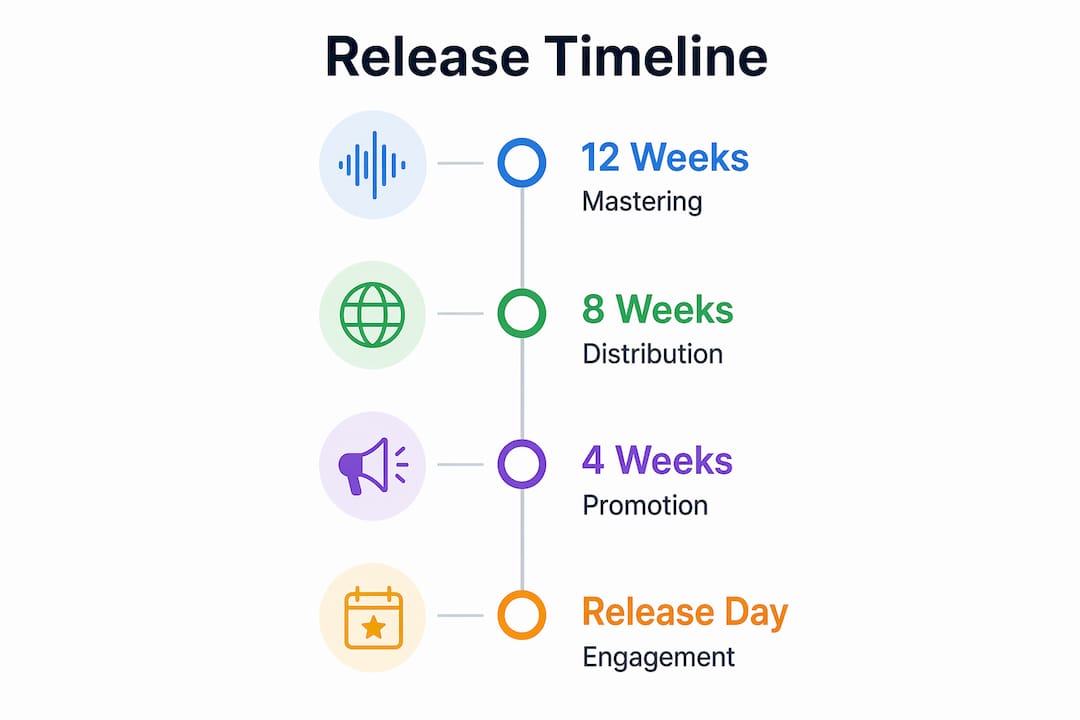
Professional releases often schedule dates 4–6 months ahead to build integrated brand identity and algorithm signals before music hits platforms. For independent artists, even 10–12 weeks of disciplined planning produces a measurable difference.
How do you build a multi-phase content and marketing plan?
A multi-phase content strategy covers three distinct windows: pre-release anticipation, release-week engagement, and post-release sustain. Each phase has a different goal, and treating them as one continuous push is a common mistake that dilutes your impact.
Music marketing is distinct from promotion. Marketing builds brand and story over time, while promotion drives immediate actions like streams or ticket sales. You need both working together, and the content phases are where that alignment happens.
Pre-release: build anticipation
Post short teaser clips (15–30 seconds) on TikTok and Instagram Reels starting 4–6 weeks out
Share studio footage, lyric snippets, and artwork reveals to create a story around the song
Use a landing page to collect email signups before the song is even available
Announce the release date clearly and repeat it across platforms
Release week: push hard
Send a dedicated email to your list on release day with a direct link
Post across all platforms simultaneously
Run paid ads on Meta (Facebook and Instagram) targeting your existing audience and lookalikes
Pitch to independent playlist curators through SubmitHub or Groover
Post-release: sustain the momentum
Share fan reactions, covers, and user-generated content
Post performance videos and acoustic versions
Keep running ads for at least 2–4 weeks after release
Analyze your Spotify for Artists data to see which cities and demographics are responding
Listeners are 74% more likely to discover music via short-form video platforms compared to average users. That number makes TikTok and Reels non-negotiable parts of any release plan, not optional extras.
Pro Tip: Film 10–15 short video clips during your recording sessions. You will have content ready for every phase without scrambling to create it under pressure.
What platforms and tools should independent artists prioritize?
The right tools depend on your goals, but a few are non-negotiable for any serious release campaign.
Spotify for Artists is the foundation. It gives you access to editorial pitching, real-time streaming analytics, and audience demographic data. You cannot run a data-driven release without it.
TikTok and Instagram Reels are your primary discovery engines. Short-form video is where new listeners find music in 2026. Consistent posting in the weeks before and after release builds the algorithm signals that push your content to new audiences.
Feature.fm and ToneDen are the leading pre-save tools. Pre-saves signal demand to Spotify before your song is live, which can influence algorithmic playlist placement on release day.
Routing traffic through landing pages rather than directly to streaming platforms lets you capture email signups and measure listener conversion beyond raw click counts. That data makes every future ad campaign more efficient.
Email marketing is the most underused tool in independent music. Building an email list is the only way to own your fan connection directly, without depending on platform algorithms. Nurtured superfans respond best to exclusive previews and behind-the-scenes content, and they convert at higher rates than cold social media followers.
Tool | Primary Function | Best For |
Spotify for Artists | Editorial pitching, analytics | Playlist placement, audience data |
TikTok / Instagram Reels | Short-form discovery content | New listener acquisition |
Feature.fm / ToneDen | Pre-save campaigns | Pre-release momentum |
SubmitHub / Groover | Playlist curator outreach | Independent playlist placement |
Mailchimp / ConvertKit | Email marketing | Superfan engagement, owned audience |
For rock music marketing strategies specifically, the combination of email, short-form video, and pre-save campaigns consistently outperforms relying on any single platform.
What mistakes do artists make when releasing music?
Most release failures come down to the same handful of avoidable errors. Knowing them in advance is half the battle.
Missing editorial pitch deadlines. Spotify’s editorial team requires pitches at least 7 days before release. Most artists who miss this window never get it back. Metadata errors or late pitching after upload drastically reduce editorial playlist chances, and post-upload fixes are often impossible without losing streaming history.
Skipping the pre-save campaign. Pre-saves generate day-one streams and signal demand to Spotify’s algorithm. Skipping this step means starting from zero on release day with no momentum built.
Sending traffic directly to Spotify. Every ad that sends a listener straight to a streaming platform is a missed opportunity to capture their email address and retarget them later.
Going quiet after release week. The post-release sustain phase is where most independent artists drop off. Algorithms continue to reward tracks that keep accumulating streams in weeks 2–4.
Releasing an album before testing singles. Releasing 2–3 singles before a full album rollout increases exposure and reduces promotional waste. Singles let you test which creative assets and marketing angles actually resonate before you commit your full budget to an album campaign.
“Treat your upload date as the midpoint of your campaign, not the finish line. Everything before it builds the fire. Everything after it keeps it burning.”
Understanding the current issues shaping music in 2026 helps you make smarter decisions about timing, platform priorities, and where to focus your energy.
Key takeaways
A successful music release strategy requires disciplined pre-release planning, phased content execution, and sustained post-release promotion to maximize streaming algorithm impact and fanbase growth.
Point | Details |
Start planning early | Singles need 6–8 weeks minimum; albums need 10–12 weeks for full campaign execution. |
Pitch before you upload | Submit to Spotify editorial at least 7 days before release, ideally much earlier. |
Use all three content phases | Pre-release, release week, and post-release sustain each serve a distinct purpose. |
Own your audience | Build an email list using landing pages so you are not dependent on platform algorithms. |
Test singles before albums | Release 2–3 singles first to refine your marketing and reduce wasted ad spend. |
What i’ve learned from planning releases the hard way
Here is the honest truth about release planning: most independent artists treat it like an afterthought, and then wonder why their numbers are flat. I have watched talented musicians pour everything into recording and then upload their music with two days’ notice and no pre-save, no pitch, no email blast. The song deserved better. The artist deserved better.
The discipline of planning 8–10 weeks out changes everything. Not because the music gets better, but because the audience actually has a chance to find it. The artists I have seen break through consistently are not always the most talented. They are the most prepared.
The other thing I keep coming back to is the difference between chasing streams and building fans. Vanity metrics feel good for a day. A superfan who opens every email, buys the merch, and shows up to every show is worth a hundred passive listeners. Superfan development generates outsized returns because those people are invested in your story, not just your sound.
Winteragony’s approach to the reunion has been built around exactly this idea. Share the real story. Let people into the process. Use every platform to tell a consistent narrative, not just to drop links. That is what turns a release into a moment people remember.
— Travis
Plan your next release with Winteragony
Ready to put this into practice? Winteragony has been building and sharing hard-won knowledge from years of independent releases, reunions, and real-world music marketing in the rock and metal space.
Whether you are planning your first single or mapping out a full album rollout, the resources and perspectives at Winteragony are built for artists who take their craft seriously. Dig into the blog, study the release timelines, and use the frameworks here to build a campaign that gives your music the audience it deserves. The music is already done. Now make sure the world actually hears it.
FAQ
How far in advance should i plan a single release?
Singles require a minimum of 6–8 weeks of lead time to cover distribution, editorial pitching, and pre-release promotion. Starting earlier gives you more time to build pre-save momentum and content.
What is a pre-save campaign and why does it matter?
A pre-save campaign lets fans save your unreleased song to their Spotify library before it goes live. Pre-saves generate day-one streams and signal demand to Spotify’s algorithm, improving your chances of playlist placement.
Do i need a landing page for my music release?
Yes. Routing listeners through a landing page instead of directly to Spotify lets you capture email addresses and retarget them with future campaigns, making every ad dollar more effective.
How many singles should i release before an album?
Releasing 2–3 singles before a full album rollout is the standard approach. It builds audience familiarity, tests which creative angles work, and reduces wasted promotional spend on the full release.
What is the most overlooked part of a music release?
The post-release sustain phase is where most independent artists go quiet. Continuing to post content and run ads for 2–4 weeks after release keeps streams growing and signals ongoing relevance to streaming algorithms.
Recommended

Comments