


How Music Videos Evolved: From Illustrated Songs to AI
- Travis B
- 6 days ago
- 9 min read

Most people assume music videos started with MTV. The truth is the format is far older, rooted in illustrated songs from the late 19th century and early 20th century, long before television existed. Every technological leap since then opened new creative doors, and for hard rock and heavy metal artists, those doors led somewhere genuinely powerful. From video jukeboxes in smoky diners to AI-generated visuals that match the chaos of blast beats, the story of music videos is one of constant reinvention. This article breaks down every major era, the technology behind each shift, and what it all means for the metal community today.
Table of Contents
Key Takeaways
Point | Details |
Music videos trace back a century | Illustrated songs and video jukeboxes set the roots of music videos long before MTV. |
MTV boosted metal visibility | MTV’s launch brought hard rock and metal videos mainstream recognition and creativity. |
Technology drives creativity | Digital tools, AI, and YouTube have enabled new forms of artistic expression for metal videos. |
Videos foster fan communities | Music videos are powerful for deepening themes, building identity, and uniting fans. |
DIY and AI are future trends | Fan-driven, AI-enhanced videos are reshaping creativity and participation in metal music culture. |
Origins: Illustrated songs to video jukeboxes
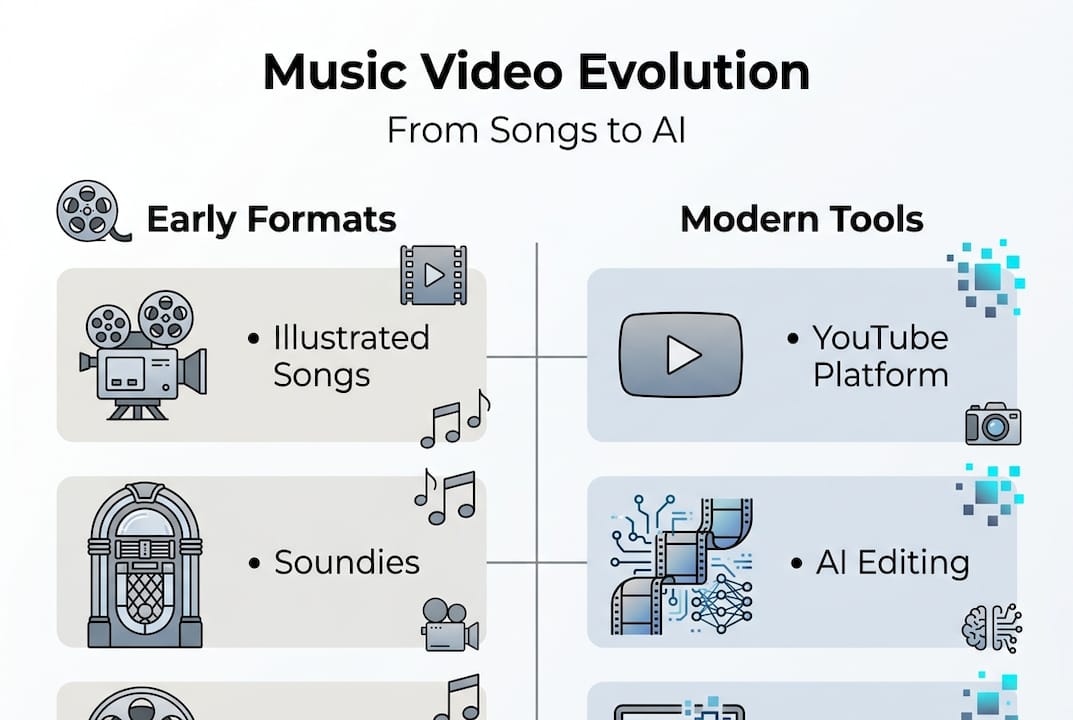
The idea of pairing visuals with music is not a modern invention. Back in the early 1900s, illustrated songs were a common form of entertainment in American theaters and nickelodeons. A singer would perform while hand-painted lantern slides were projected behind them, syncing color and imagery to melody. It was primitive by today’s standards, but the intent was the same: make music more immersive by adding something for the eyes.
By the 1940s, technology pushed that idea forward in a big way. Soundies were short musical films, roughly three minutes long, played on coin-operated machines called Panorams. Audiences could walk up, drop a coin, and watch a musical performance play out on a small screen. It was the jukebox, but with video. Then in the 1960s, Scopitones arrived from France and refined the format further, featuring color film and a wider variety of artists. These machines showed up in bars, cafes, and lounges across America and Europe.
These formats laid the groundwork that would eventually support everything from music video history milestones to today’s AI-driven visuals. The core principle never changed. You pair a strong song with a compelling visual experience, and you get something people remember longer than the song alone.
Here is a quick look at how these early formats stacked up:
Format | Era | Key feature |
Illustrated songs | 1890s to 1920s | Projected slides synced to live performance |
Soundies | 1940s | Short films on coin-operated Panoram machines |
Scopitones | 1960s | Color film, café and bar format, wider artist variety |
What made each of these formats matter:
They normalized the idea that music needed a visual companion
They built an audience expectation that persisted across decades
They created a commercial model where artists benefited from visual exposure
They showed that technology, no matter how early, could amplify artistic intent
For heavy metal and hard rock, that last point matters a lot. The genre has always used visual language to say what lyrics alone cannot. The seeds of that approach were planted in illustrated songs and video jukeboxes long before anyone imagined distorted guitars.
MTV, hard rock, and metal: The revolution begins
When MTV launched on August 1, 1981, with “Video Killed the Radio Star” by The Buggles, it did not just change how people watched music. It changed how music was made, marketed, and experienced. The MTV launch in 1981 gave artists a platform that demanded both sonic and visual identity, and heavy metal answered that call louder than most.
Iron Maiden’s self-titled track became one of the first metal videos to air on the channel, putting the genre in front of millions of mainstream viewers. That moment shifted things. Suddenly, a band’s look, their stage presence, and their visual storytelling carried as much weight as their riffs. Labels started investing in video budgets. Directors got creative. Metal bands got theatrical.
Queen had already been setting standards before MTV existed. Their “Bohemian Rhapsody” video from 1975 is widely credited as a format pioneer, demonstrating that a video could be an art piece rather than just a performance clip. Once MTV gave that approach a mass distribution channel, other bands followed fast.
Here is how the MTV era compared to what came before:
Pre-MTV era | MTV era |
Videos rare, mostly performance clips | Videos expected for every single |
Limited audience reach | Millions of daily viewers |
Low production budgets | Major label investment in video budgets |
Artist-driven visuals | Director-driven narratives with artistic collaboration |
Some defining moments from the MTV metal era:
Iron Maiden’s early MTV airings put metal on the mainstream map
Motley Crue and Twisted Sister used theatrical visuals to build massive fanbases
Metallica’s “One” blended war footage with music for a visceral, anti-war statement
Pearl Jam’s “Jeremy” pushed boundaries so far it faced censorship and edits
Rammstein’s videos consistently provoked controversy and ignited debate about artistic limits
“The video is not decoration. For metal, it is part of the argument the song is making.”
Learning more about music creativity in hard rock shows just how tightly visual storytelling became woven into the genre’s DNA during this period. If you want to see some of the most impactful music videos that came out of this era, the examples are still striking today.
How technology reshaped music videos
Once music videos had captured mainstream attention, technological advancements began to change both the process and the art itself. The 1980s brought CGI into the frame. It was expensive and rough by modern standards, but it opened a door. Bands could now create visual worlds that had nothing to do with physical sets or real locations.

Fast editing became its own language in the 1990s. Quick cuts, matched to drum hits or guitar accents, gave metal videos a kinetic energy that felt true to the music. Directors like Samuel Bayer, who shot Nirvana’s “Smells Like Teen Spirit,” helped normalize a raw, fast-cut aesthetic that influenced metal video production for years.
Then YouTube arrived in 2005 and changed everything about distribution. Suddenly, a band did not need a label deal or MTV airtime to reach millions. Independent metal acts could upload a video shot on a consumer camera and build a global audience. Costs dropped dramatically. The barrier to entry basically disappeared.
The result? A massive surge in creative variety across the genre.
More recent tools have pushed things even further:
Drone footage brought cinematic aerial shots to bands with modest budgets
VR and AR opened immersive, 360-degree video experiences for fans
AI visual tools now let artists generate surreal, thematic imagery that would have cost a Hollywood budget a decade ago
Bands like Igorrr used ethically trained AI for visuals that match the chaos of glitch-influenced drumming, as documented in music video technology impact research
Stat to consider: Independent metal artists who adopted YouTube early saw subscriber growth that outpaced many label-backed acts, simply by releasing consistent video content without a gatekeeper in the way.
Pro Tip: If you are a metal artist working with a small budget in 2026, AI video generation tools are genuinely usable at the bedroom-studio level now. Pair them with strong conceptual direction and you can produce something that feels intentional and original. Check out some innovative AI music videos for real-world examples, and dig into AI-driven music video tips to start building your own approach.
Technology did not replace artistry in metal videos. It gave artists more tools to express what was already inside them.
Community, meaning, and censorship in metal videos
With technology powering new creative possibilities, metal music videos also grew in their meaning, community impact, and confrontational spirit. A great metal video is rarely just entertainment. It is a statement, sometimes a provocation, and often a rallying point for a community that has always existed a little outside the mainstream.
Music videos enhance thematic depth and foster fan communities in ways that pure audio simply cannot. Iron Maiden’s videos built a mythology around Eddie, their iconic mascot, that fans could see and share. Metallica’s “One” used footage from the 1971 film “Johnny Got His Gun” to create an anti-war narrative so powerful it still gets discussed in classrooms. These videos gave fans a shared visual language, a set of images and symbols that meant something specific to people who belonged to the culture.
“Metal fans do not just listen to the music. They live inside the imagery, the mythology, and the values the videos project.”
That shared identity is part of why emotion and fan engagement run so deep in this genre. Here is what metal videos have done for community and meaning:
Anti-war and social justice narratives gave fans a sense of purpose beyond entertainment
Mythic visual storytelling (Iron Maiden, Amon Amarth) built fictional worlds fans could inhabit
DIY and low-budget aesthetics made fans feel like the music was genuinely for them, not a product
Visual iconography became a shared identity marker, visible on shirts, tattoos, and fan art
Censorship is also part of this story, and honestly, it is a badge of honor for a lot of metal acts. Pearl Jam’s “Jeremy” was edited after its original version was deemed too graphic for television. Rammstein has had videos banned or restricted in multiple countries. Rather than silencing these artists, the controversy amplified their reach and reinforced their credibility with fans who valued exactly that kind of boundary-pushing spirit.
Pro Tip: If you are making a video with challenging themes, think about what you are actually trying to say before worrying about what is allowed. The videos that faced the most resistance also created the most fan connection in metal videos over time.
What most fans miss about the evolution of metal music videos
Here is what we actually think, and it is based on being inside this genre for a long time. Most fans talk about the legendary videos, the Metallicas and the Iron Maidens, and they think the story of metal video evolution is mostly about what the big names did with big budgets. That is only part of it.
The real shift happened when the tools reached regular people. YouTube did not just let bands upload videos. It let fans make their own, respond to the music visually, and create content that sometimes rivaled what labels were producing. AI is doing the same thing right now, only faster and more accessibly.
We have been working with AI tools for our own visual output, and what surprises us is how much creative control you actually retain. The technology does not replace your vision. It helps you execute it without needing a six-figure production budget. The line between artist and audience is genuinely blurring, and we think that is the most exciting thing to happen to metal video culture in decades.
If you want to see where that is heading, look at fan-driven video innovations happening right now. The next iconic metal visual moment might not come from a label. It might come from a fan with a laptop and a real idea.
Connect with the next wave in metal music video creativity
If this story of evolution has you fired up about what is possible in metal video art, you are in the right place.

At Winter Agony, we are a hard rock and heavy metal band from Kentucky who have been living this journey since 2005. We use AI tools for our own music videos and share everything we learn with the community. If you want to go deeper, whether you are a fan, a creator, or both, the metal music video blog has practical insight, real examples, and honest perspectives on where this art form is heading. Come be part of the conversation. The creative future of metal visuals is being written right now.
Frequently asked questions
What was the first music video ever made?
The earliest music video concepts appeared as illustrated songs in the late 19th century, but video jukeboxes like Soundies popularized the format in the 1940s.
How did MTV influence hard rock and metal music videos?
MTV’s launch in 1981 brought metal videos like Iron Maiden to mass audiences and established music video as a core part of artist branding and identity.
What technologies have most impacted metal music videos recently?
Recent advances like AI, VR, drones, and fast digital editing have enabled both artists and fans to create more surreal and thematic metal videos than ever before.
How do music videos build community among metal fans?
Videos enhance thematic depth and foster connection through shared narrative and visual experiences, which strengthen fan identity across generations.
Are there famous metal videos that faced censorship?
Yes, videos like Pearl Jam’s “Jeremy” and Rammstein’s work have pushed boundaries and sometimes faced bans or edits due to their confrontational visual content.
Recommended
Comments