


Music creativity: How songwriting fuels emotion in hard rock
- Travis B
- Apr 14
- 8 min read


Creativity in music isn’t some gift handed down to a lucky few. It’s a learnable process rooted in how your brain works, what you’ve lived through, and how honestly you’re willing to put that on paper. In hard rock and heavy metal especially, the most powerful songs aren’t always the most technically complex. They’re the ones that hit you somewhere real. Whether you’re a songwriter trying to break through a creative wall or a fan who wants to understand why certain riffs and lyrics feel like they were written just for you, understanding the mechanics behind music creativity changes everything.
Table of Contents
Key Takeaways
Point | Details |
Creativity is learnable | Musical creativity relies on brain processes like pattern recognition and is accessible to all musicians. |
Emotion drives impact | Authentic emotional expression in songwriting makes hard rock and metal tracks memorable. |
Real-world factors matter | Financial pressures and technology directly influence output, recognition, and creative confidence. |
Actionable frameworks exist | Iterative writing, collaboration, and data-informed routines consistently unlock new creative doors. |
The neuroscience of music creativity
Your brain does something remarkable when music plays. It doesn’t just process sound. It predicts, reacts, and rewards. Music activates brain reward systems through a mix of predictability and surprise, which is exactly why a well-placed breakdown or an unexpected chord shift can feel almost physical. That tension between what you expect and what you get is at the heart of why music moves people.
Divergent thinking is the mental process of generating multiple possible solutions or ideas from a single starting point. In songwriting, this shows up when you take one emotional experience and explore every angle of it. A riff, a lyric, a tempo shift. All of it branching from one raw feeling. Pattern recognition works alongside divergent thinking. Your brain constantly maps what it hears against what it already knows, which is why musicians who’ve absorbed thousands of hours of music can instinctively feel when something works.
Professional musicians show higher levels of divergent thinking, openness to experience, creative self-efficacy, and intrinsic motivation compared to non-musicians. That’s not a coincidence. Those traits are built through practice and emotional investment in the craft.
Flow states matter too. Flow is that locked-in feeling where time disappears and the music just pours out. Neuroscience links flow to reduced activity in the prefrontal cortex, the part of the brain responsible for self-criticism. Less inner critic means more honest creative output.
Trait | Musicians | Non-musicians |
Divergent thinking | High | Moderate |
Pattern recognition | Advanced | Basic |
Creative self-efficacy | Strong | Variable |
Openness to experience | Elevated | Average |
Intrinsic motivation | High | Lower |
Measurable edge | Baseline |
“The brain doesn’t separate emotion from music. They’re processed together, which is why a song can feel like a memory you never actually had.”
This is the foundation. Once you understand that creativity is a brain function you can train, the whole game changes.
Songwriting and emotional storytelling in hard rock and metal
Hard rock and metal have always had a complicated relationship with emotion. The genre rewards aggression, power, and heaviness. But the songs that last, the ones that get tattooed on people’s arms and played at funerals, are the ones that crack open something vulnerable.
Pantera’s “Cemetery Gates”) is a perfect example. It’s a power ballad in a genre that often frowns on softness, and it’s one of the most emotionally devastating songs in metal history. Metallica’s “Fade to Black” works the same way. Both tracks use space, dynamic contrast, and deeply personal lyrics to pull listeners in. These aren’t accidents. They’re intentional emotional architecture.
The pressure for constant heaviness in metal can actually box songwriters in. When the genre’s identity becomes more important than the song’s truth, creativity suffers. The best metal songwriters push back against that.
Common themes that show up in hard rock and metal lyrics include:
Loss of a loved one or relationship
Childhood trauma and family struggle
Emotional withdrawal and isolation
Identity and the search for belonging
Anger as a response to powerlessness
Lyrical technique | Power ballads | Traditional heavy tracks |
Emotional vulnerability | High | Low to moderate |
Dynamic contrast | Soft to loud builds | Consistent intensity |
Personal narrative | First-person, confessional | Often abstract or fictional |
Melodic range | Wide, expressive | Narrow, aggressive |
Listener connection | Deep and lasting | Immediate and energizing |
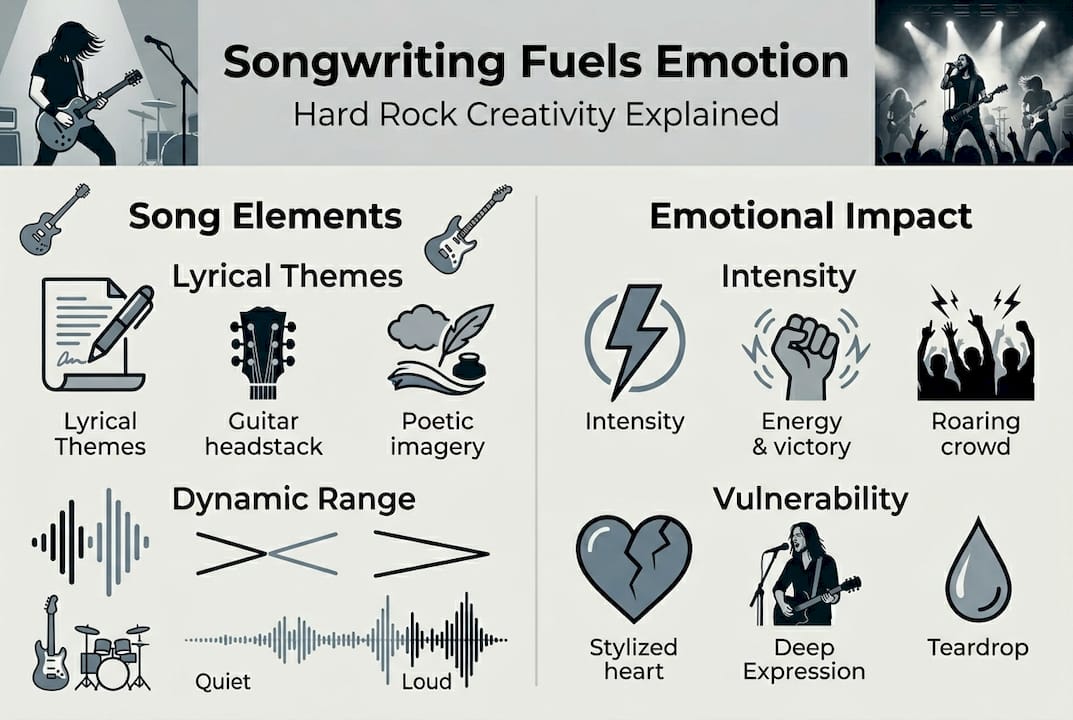
Pro Tip: Use contrast deliberately. A quiet, clean guitar intro before a heavy chorus doesn’t weaken the song. It makes the heavy part hit harder. Shifting from a minor key verse to a major key chorus can carry a listener from grief to defiance in four bars. That’s emotional storytelling at its most efficient.
The full history and emotional psychology behind “Fade to Black” shows just how much a single song can carry when it’s written from a place of genuine pain. That’s the standard worth chasing.
Real-world forces: What boosts or blocks your creativity?
Creativity doesn’t exist in a vacuum. It lives inside a life, and that life has bills, stress, relationships, and limitations. Understanding what actually affects your output matters as much as understanding the creative process itself.
Money is a bigger factor than most musicians want to admit. Financial insecurity reduces composers’ output by 15.7%, cuts popularity by 50%, and drops significance by 13.9%. That’s not just a personal struggle. It’s a measurable creative loss. When you’re worried about rent, the part of your brain that needs to feel safe enough to be vulnerable shuts down.
But there are real tools and habits that push back against that.
Top three modern creativity boosters:
Collaboration. Working with another musician forces you out of your own patterns. You hear your ideas reflected back differently, and that friction generates new directions.
AI tools. AI tools enhance self-efficacy and emotional intelligence in music students and professionals. We’ve used AI ourselves in building new music videos and vocal experiments. It’s a genuine creative accelerator when used right.
Journaling ideas. Not every idea is a song. But every idea is a seed. Writing down fragments, moods, single lines of lyric, keeps the creative pipeline moving even on hard days.
Steps to protect your creativity under pressure:
Set a non-negotiable creative window each day, even 20 minutes.
Separate the writing session from the judgment session. Create first, edit later.
Use voice memos to capture ideas the moment they appear.
Build a small creative community around you, even one other person who gets it.
Track your output weekly so you can see progress even when it feels invisible.
Pro Tip: AI is a great tool for generating chord progressions or lyric prompts when you’re stuck. But don’t hand it the emotional core of your song. That part has to come from you. The machine can suggest. Only you can mean it.
Actionable frameworks for unlocking your musical creativity
Knowing that creativity is trainable is one thing. Having a system for actually doing it is another. Here’s what the research and real experience point to.
Iteration matters more than inspiration. Most great songs go through multiple drafts. The first version of a lyric is rarely the truest version. Writing the same idea three different ways forces you to find the one that actually fits. Large datasets benchmarking musicians confirm that memory, executive function, and creative output all improve with structured, repeated practice over time.
Collaboration introduces emotional range you can’t generate alone. When you write with someone else, you’re forced to articulate why a lyric works or doesn’t. That articulation sharpens your instincts.
Four proven strategies for sparking creativity:
Musical journaling: Write one musical idea every day, no matter how small. A chord, a lyric fragment, a tempo. Volume builds creative muscle.
Weekly collaboration sessions: Even a one-hour session with another musician resets your perspective and breaks habitual patterns.
Data-driven song analysis: Listen back to your old songs and track what worked emotionally. Look for patterns in the songs you’re most proud of.
Routine shifts: Change where you write, what time you write, or what instrument you start on. New environments trigger new neural pathways.
| Framework | Best for | Key benefit | Limitation | |—|—|—| | Solo writing | Deep personal work | Full creative control | Can become repetitive | | Group collaboration | Range and variety | Fresh perspectives | Requires compromise | | AI-assisted writing | Overcoming blocks | Fast idea generation | Lacks emotional depth | | Intuition-driven | Spontaneous creativity | Authentic expression | Hard to replicate |
Tracking your creative output regularly, even just a simple log of what you worked on and how it felt, builds self-awareness over time. You start to notice when you’re most creative, what conditions help, and what drains you. That knowledge is one of the most underused tools in a musician’s kit.
Why real emotion outranks technical perfection in music creativity
We’ve been playing and writing music long enough to say this with confidence: technical skill will get you respect, but emotional honesty will get you remembered. In hard rock and metal, where the culture often prizes precision and power, this truth gets buried more than it should.

Power ballads like “Cemetery Gates”) didn’t break through because Dimebag played perfectly. They broke through because the song said something real. And genre expectations that demand constant aggression can quietly kill that kind of honesty before it ever makes it to the recording booth.
The musicians who leave the deepest marks are the ones willing to be vulnerable in a genre that doesn’t always make room for it. Technical perfection is a ceiling. Emotional truth is a door. You can practice your way to better technique, but you have to live your way to better stories. Our advice: write the song that scares you a little. That’s usually the one worth finishing.
Take your music journey further with Winter Agony
If this resonated with you, you’re already thinking about music the right way. Creativity rooted in real emotion, honest storytelling, and a willingness to push past genre limits is exactly what drives everything we do in Winter Agony.
We’ve been writing from that place since 2005, and our reunion has brought new energy, new technology, and new tracks that carry the same emotional weight we’ve always believed in. If you want to hear what that sounds like, explore the US emotional rock scene and see where it takes you. You can also dig into the Winter Agony discography and find the songs that hit closest to home. Your creative journey and ours might have more in common than you think.
Frequently asked questions
How do professional musicians develop greater music creativity?
They practice divergent thinking, stay open to new experiences, and maintain strong intrinsic motivation. Professional musicians show higher creative self-efficacy and passion for their craft compared to non-musicians, and those traits are built over time, not born overnight.
How do AI tools help with songwriting and creativity?
AI tools can generate ideas, reduce creative blocks, and build confidence. AI positively impacts creativity by enhancing self-efficacy and emotional intelligence, especially when used as a starting point rather than a replacement for personal experience.
What are the most common barriers to music creativity?
Financial stress and rigid genre expectations are two of the biggest obstacles. Financial insecurity measurably reduces both output and impact for composers and songwriters, making stability a genuine creative resource.
How do hard rock and metal musicians show emotion in their songwriting?
They lean into power ballads, personal lyrics, and dynamic contrast to express raw feeling. Songs like Pantera’s “Cemetery Gates”) and Metallica’s “Fade to Black” show how vulnerability can coexist with heaviness and create something that lasts.
Recommended
Comments