


Why emotional music connects: The power behind metal
- Travis B
- 2 days ago
- 10 min read


People hear “heavy metal” and immediately picture smashed guitars, screaming, and chaos. We’ve seen that look a thousand times, and honestly, it used to frustrate us. Because anyone who has ever stood in a crowd with five hundred other people, all of you locked into the same crushing riff at the same moment, knows there is nothing empty or mindless about that experience. There is something real happening in that room, something that researchers are now starting to map with actual science, and it runs a lot deeper than most people expect.
Table of Contents
Key Takeaways
Point | Details |
Brain-based connection | Emotional music triggers powerful brain mechanisms, especially when it is self-chosen. |
Identity and memory links | Songs from adolescence shape identity and create lasting emotional ties. |
Metal’s resilience effect | Hard rock and metal help fans process emotion and build resilience contrary to stereotypes. |
Community amplifies impact | Group fandom and music communities deepen emotional connections and well-being. |
How emotional music connects: Brain, body, and memory
With the common myth addressed, let’s go deeper into how our brains and bodies actually respond to emotional music and why it feels so meaningful.
Music doesn’t just float past you. It gets inside you, and there are real, documented reasons for that. Researcher Patrik Juslin identified eight distinct mechanisms through which music triggers emotional responses. Music induces emotions through brain stem reflexes, rhythmic entrainment, evaluative conditioning, emotional contagion, visual imagery, episodic memory, musical expectancy, and aesthetic judgments. That’s a lot of entry points. Your body is essentially getting hit from multiple angles at once, and heavy music tends to activate several of them simultaneously.
Here’s a quick breakdown of what each mechanism actually does:
Brain stem reflex: A loud, sudden sound triggers a physical startle response. Heavy music uses this intentionally.
Rhythmic entrainment: Your heartbeat and breathing start to sync with the tempo of what you’re hearing.
Evaluative conditioning: If you first heard a song during a powerful moment in your life, that emotion gets permanently linked to the track.
Emotional contagion: You “catch” the emotion of the performer, like picking up someone else’s energy in a room.
Visual imagery: The music creates pictures or scenes in your mind, which then carry their own emotional weight.
Episodic memory: A song pulls up an entire memory, complete with all the emotions you felt at that time.
Musical expectancy: Your brain predicts what comes next, and when the song surprises you, it creates a surge of feeling.
Aesthetic judgment: You appreciate the craft of what you’re hearing, and that recognition itself generates emotion.
“Emotional music connects via innate mechanisms mimicking caregiver-infant bonds and evolutionary social functions, personalized by culture and memory.”
The brain areas involved include the nucleus accumbens (the core of the reward system), the amygdala (emotional processing), and the hippocampus (memory). When all three light up together, which heavy music is very good at triggering, you get something that feels almost overwhelming. That’s not an accident. That’s your brain doing exactly what it was built to do. Emotional storytelling in music is one of the oldest human tools we have, and hard rock and metal use it at full volume.
Brain Region | Role in Music Response |
Nucleus accumbens | Releases dopamine during emotional peaks |
Amygdala | Processes fear, joy, and intense emotional content |
Hippocampus | Links music to autobiographical memory |
Medial prefrontal cortex | Connects music to personal identity |
The fact that these responses are partly evolutionary, rooted in how early humans used sound for bonding and communication, means songwriting and emotion in hard rock tap into something that has been wired into us for tens of thousands of years.
Why self-selected music, especially from your youth, hits hardest
Now that we know why music moves us, it’s time to see why personal choice and especially songs from certain parts of your life matters so much.
Not all music hits the same. The songs you actively choose for yourself engage your brain very differently than music that just happens to be playing in a store or restaurant. Self-selected music engages reward and identity circuits more strongly, which explains why your personal playlist feels like a direct line to your soul while elevator music just disappears into the background.
Here are three concrete ways your personal music choices shape your emotion and identity:
Identity reinforcement: When you choose heavy music, you’re making a statement about who you are. Your brain registers that choice and deepens the connection between the music and your sense of self.
Emotional ownership: Music you select yourself feels like it belongs to you. That ownership makes the emotional response more personal and more intense.
Memory anchoring: Self-chosen songs become the soundtrack to specific chapters of your life, which means they carry all of that emotional context forever.
Now add the adolescence factor and things get even more intense. Music from adolescence creates strong emotional connections due to the “reminiscence bump,” a well-documented psychological phenomenon where memories from roughly ages 12 to 25 are recalled more vividly than memories from any other period. During those years, you’re forming your identity, experiencing love and loss for the first time, and figuring out where you fit in the world. The music that was playing during all of that gets permanently fused to those moments.
This is why so many metal and hard rock fans describe their favorite albums almost like old friends. That isn’t nostalgia for the sake of it. It is literally your brain doing its job, maintaining the emotional architecture of who you became. Understanding how music shapes life through those formative years helps explain why these connections feel almost sacred.
Pro Tip: If you want to use music intentionally for self-discovery or healing, go back to the albums you loved between ages 15 and 22. Notice what emotions they bring up. Those feelings often point directly to unresolved experiences or core values that still drive you today.
The emotional journey: How heavy music channels anger and builds resilience
Understanding how personal music selections impact emotion paves the way to ask: What makes heavy genres like metal and hard rock so distinctive for emotional processing and growth?
Here is the stereotype that drives us crazy: people assume that because the music sounds aggressive, it must make listeners more aggressive. The research says the opposite. For heavy metal and hard rock fans, music provides catharsis for intense emotions like anger, reduces stress, and builds resilience without increasing aggression. Catharsis means a release, not an escalation. You go in with the anger, the music gives it somewhere to go, and you come out calmer.
An Australian study found that heavy metal listening helps process anger, reduces cortisol (the primary stress hormone), fosters belonging, and acts as a coping mechanism. Participants in the study showed no increase in violent behavior after listening. In fact, many reported feeling more emotionally settled. That tracks completely with what we hear from our own community.
And there’s more. Active music engagement correlates positively with resilience scores on the CD-RISC scale, which is one of the standard psychological measures for resilience. People who actively engage with music, not just passively hear it, score higher on their ability to bounce back from adversity.
Here’s a direct comparison of what people assume versus what the research actually shows:
Common stereotype | What research actually finds |
Metal makes people violent | Reduces aggression and cortisol levels |
Heavy fans are emotionally unstable | Higher emotional resilience scores |
Angry music creates angrier people | Provides cathartic release of difficult emotions |
Heavy music is antisocial | Builds strong community and belonging |
Loud music damages mental health | Active engagement supports well-being |
The mental health benefits that heavy music delivers are real and they include:
Cathartic release of built-up anger and frustration
Reduction in cortisol and physiological stress responses
A strong sense of community and belonging
Emotional validation during difficult personal periods
Improved mood and sense of personal power
Pro Tip: When stress is genuinely overwhelming you, put on the heaviest thing in your library and listen actively. Don’t use it as background noise. Focus on the riffs, the drums, the vocals. That intentional engagement is what triggers the stress-reducing response.
Understanding how to express emotion in metal is something musicians and fans both benefit from, and it’s one of the reasons we’ve always tried to make sure every track we write has real emotional weight behind it. And tracing the hard rock sound history shows that this emotional directness has been the genre’s core strength from the very beginning.
Belonging, identity, and the collective power of heavy music
Beyond personal resonance, there’s a unique social and cultural dimension in heavy music fandom and here’s how that amplifies emotional connection.
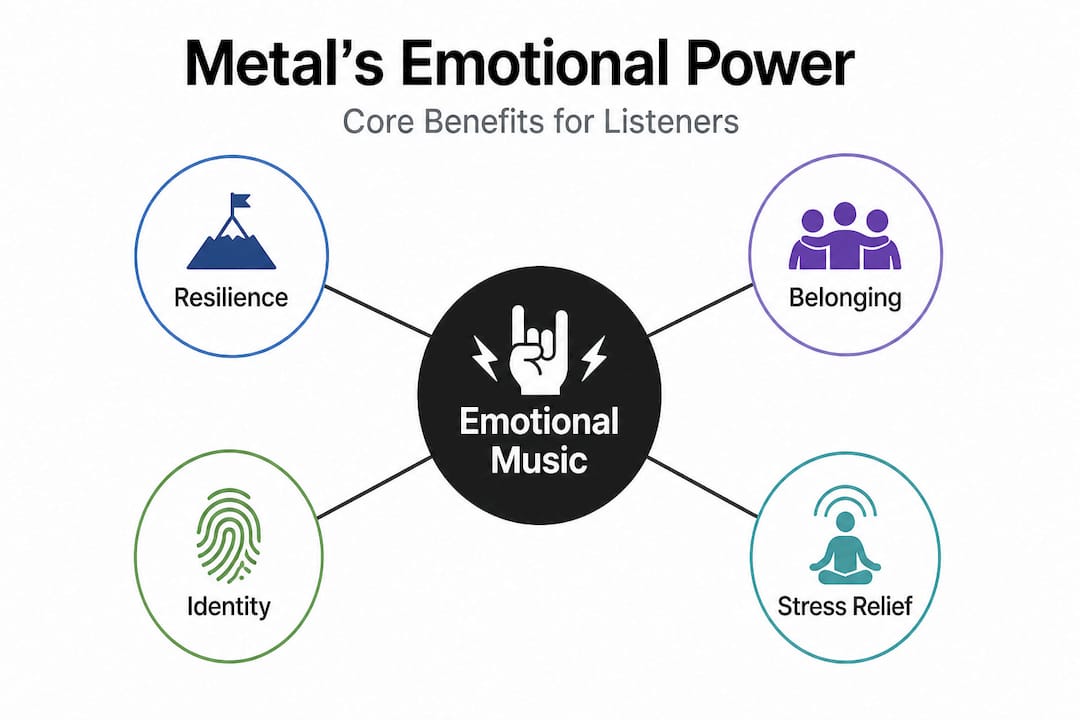
One of the most powerful things that happens at a metal show isn’t the music itself. It’s looking around and realizing that every single person in that room gets it. They feel what you feel. They’ve been through what you’ve been through. That recognition is not a small thing. It is the foundation of human emotional wellbeing.
Metal fans use music for emotion regulation, identity development, and social connectedness during adolescence, directly contradicting the old stereotype that heavy music fans are isolated and vulnerable. The research paints a picture of a community that uses music as a genuinely healthy tool for navigating some of the most difficult years of a person’s life.
The neuroscience backs this up even further. Group identification with performers enhances music liking through inter-brain synchronization in the temporal cortex. In plain language, when you identify strongly with a band or feel like you belong to the same tribe as the people around you at a show, your brain literally synchronizes with other brains in the room, and that synchronization deepens the emotional impact of the music. You aren’t imagining it. That collective experience is neurologically real.
Ways that community strengthens the impact of emotional music:
Shared live experiences create collective memories that bond fans together permanently
Online communities allow fans to process emotions and share personal stories in safe spaces
Band-fan bonds create a sense of being understood by someone who has lived through similar struggles
Social identity through music gives people a stable sense of self during uncertain times
Collaborative listening amplifies emotional response because the brain reads group emotion as more valid
“The social function of music goes back to our evolutionary roots. Being in sonic community with others isn’t just enjoyable. It’s deeply tied to survival instincts and emotional health.”
Music dedication in hard rock isn’t just about artistic passion. It’s about the responsibility of knowing that what you make will become part of someone else’s emotional infrastructure. We take that seriously.
A fresh take: The misunderstood emotional genius of heavy music
Having explored the science and culture, what does this all mean for fans and the outside world? Here’s our honest take.
Critics have been writing off heavy music for decades. Too loud, too angry, too much. And we get it, if you’re listening from the outside, if you’ve never been in the middle of a pit with your people, if you’ve never had a riff pull you back from a dark place, then it might just sound like noise. But that framing misses everything important.
The emotional genius of heavy music is that it doesn’t ask you to pretend. Most music smooths things out, softens the edges, keeps it comfortable. Metal and hard rock go in the opposite direction. They take the things that are genuinely hard, grief, rage, loss, confusion, and they give them a form you can actually feel in your chest. That’s not aggression for its own sake. That’s honesty with volume.
For hard rock and metal fans, “heaviness” evokes a sublime awe similar to religious experience, helping build resilience by giving listeners a way to confront overwhelming power directly. That’s not nothing. That is one of the most sophisticated emotional functions that any art form can serve.
We’ve watched people come to our shows looking like they were carrying the weight of the world, and leave looking lighter. Not because the music fixed anything. But because for an hour, the music was as big as what they were feeling, and that made them feel less alone in it. That’s why emotion in metal music matters for real wellbeing, not just entertainment.
We also want to be honest: some musicians struggle with the weight of creating dark material. The work of processing pain through art is real work, and it takes a toll. But for fans who are self-selecting this music as a coping tool, the evidence consistently shows positive outcomes. That distinction matters.
Pro Tip: Lean into the sublime. The next time a song overwhelms you, don’t pull back. Stay with it. That feeling of being emotionally overtaken is one of the most powerful healing experiences that music can provide.
Discover more and connect deeper with the music
Feeling inspired to go deeper? Here’s where to start your own emotional music journey.
We started Winter Agony in Kentucky in 2005 because we needed music that didn’t flinch. Music that told the truth about what life actually feels like. Everything we’ve talked about in this article, the science, the resilience, the community, that is the foundation of every track we’ve ever written. We’re back now, with new music that uses cutting-edge AI technology for our videos and vocal work, and the same raw honesty that has always driven us.

If any of this resonates with you, come find us. Explore our discography and hear what emotional storytelling in heavy music actually sounds like when it comes from a real place. You can also pre-order our latest release and be part of the next chapter. And if you want to know more about who we are and where we come from, learn more about Winter Agony. We’d love to have you with us.
Frequently asked questions
Why do I feel a stronger emotional connection with heavy music than with other genres?
Heavy music activates brain circuits linked to identity and emotional regulation simultaneously, providing catharsis, resilience, and social connection in a way that milder genres rarely achieve. Heavy metal and hard rock essentially give intense emotions a form that matches their actual intensity.
Can emotional music really help with stress and mental health?
Yes. Studies consistently show that emotional music, especially heavy metal, can lower stress hormones and promote mental wellbeing. Heavy metal listening reduces cortisol, helps process anger, and fosters a sense of belonging without any corresponding increase in aggression.
Why do songs from my teenage years feel so powerful?
Music from your youth attaches to identity and memory during your most formative developmental years, creating connections that last a lifetime. The reminiscence bump means those years are already stored more vividly in your brain, and music amplifies that effect dramatically.
Does heavy metal actually make people aggressive?
No. Research clearly finds that heavy metal regulates emotions without increasing aggression, and an Australian study showed no rise in violent behavior in participants after listening. The emotional release it provides actually tends to reduce stress rather than amplify it.
Is belonging to a music community important for emotional health?
Absolutely. Music fandom strengthens social bonds and supports emotional wellbeing, and that effect is especially strong in heavy genres. Metal fans use community for emotion regulation, identity development, and connection, particularly during the most challenging periods of their lives.
Recommended
Comments