


Emotional storytelling in music: A deeper fan connection
- Travis B
- 2 hours ago
- 10 min read


Most fans assume the loudest or most aggressive songs hit hardest. But research keeps flipping that idea on its head. Emotional storytelling in music lyrics actually shows that songs with sorrowful arcs and sad endings score higher with audiences, even when you strip out all the musical attributes and look only at the words. That finding changes everything about how we think about hard rock and heavy metal. It confirms what a lot of us in this genre have felt for years: the most powerful thing a song can do is make you feel truly understood.
Table of Contents
Key Takeaways
Point | Details |
Sad songs connect | Songs with sorrowful or sad emotional arcs often resonate more with listeners and even score higher in contests. |
Specificity matters | Concrete details and clear narrative stakes trigger emotional identification in fans. |
Truth over facts | Songs do not need to be autobiographical—emotional truth is what matters most. |
Techniques amplify impact | Structured narratives, tension, and release help lyrics deliver a powerful emotional punch. |
Why emotional storytelling matters in music
Having previewed the powerful role emotion plays, let’s dig deeper into why storytelling in lyrics truly matters to fans and to the genre itself.
Hard rock and heavy metal have always gotten a bad rap from the outside. Critics focus on the volume, the distortion, the aggression. What they miss is the emotional core that keeps fans coming back decade after decade. The genre isn’t just about being loud. It’s about being honest in a way that mainstream pop music often isn’t willing to be.
“Songs with sorrowful lyrical narratives and sad endings score higher in song contests, even when controlling for musical features.”
That finding from recent research makes a lot of sense to us. We’ve seen it in the songs that stay with people the longest. The ones that don’t just pump you up but actually reach inside you and grab something. That’s what emotion in metal music does when it’s done right.
When a lyric reflects something you’ve lived through, something painful or confusing or raw, you stop being just a listener. You become part of the story. That’s fan identification, and it’s one of the most powerful forces in all of music fandom.
Here’s why emotional storytelling works so well for listeners, especially in hard rock and metal:
Memory: Songs tied to emotional experiences get remembered longer and retrieved more easily from memory. A song that made you feel something at 17 can still hit the same way at 40.
Catharsis: Hearing your pain reflected in a song provides a real psychological release. You feel less alone in whatever you’re carrying.
Community: Shared emotional responses build tight fan communities. Think of any major metal fanbase and you’ll see people who bonded over the same songs during hard times.
Meaning: Emotional stories give songs layers. You can return to the same track in different seasons of life and find new meaning each time.
Identity: For a lot of fans, the music they connected with emotionally becomes part of who they are. It’s not just a soundtrack; it’s self-definition.
The impact on fan well-being is real and documented. Metal fans often report that the genre helps them process grief, anger, and anxiety in healthy ways. That doesn’t happen by accident. It happens because the songwriters were willing to go to those uncomfortable places first.
How emotional storytelling works: Mechanisms and techniques
Now that we’ve seen why emotional storytelling matters, let’s break down exactly how artists craft those emotional moments in their lyrics.

The most common structure in hard rock and metal is the verse, pre-chorus, chorus arc. It’s not just a formula. It’s a tool for building emotional stakes over the course of a song. The verse introduces the situation, often with specific, grounded details that set the scene. The pre-chorus creates tension, a sense of something about to break. The chorus is the emotional release, the moment where everything that was building finally lands.
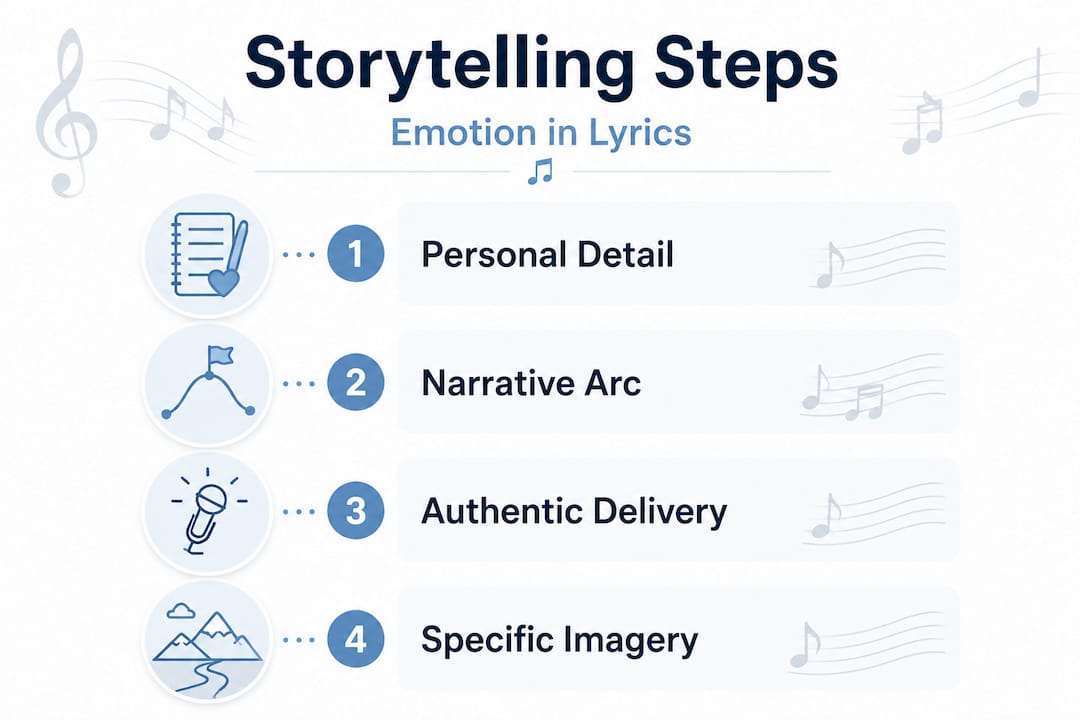
Lyric writing fundamentals confirm that lyricists build narrative stakes by escalating tension through these sections, and that specificity and concrete detail are what actually create emotional impact. Vague lyrics might sound poetic, but they don’t make people feel seen. A specific image, a named place, a sensory detail, those are what lodge a song in someone’s chest.
Here are the core techniques worth knowing:
Specificity over generality. Instead of writing “I was sad,” write about the moment, the place, the exact feeling in your body. Specificity is what triggers personal identification in the listener.
Tension and release. Structure the emotional arc of your song so there’s a build toward something. The payoff in the chorus or bridge should feel earned, not sudden.
Vulnerability without self-pity. There’s a fine line between raw honesty and wallowing. The most effective emotional storytelling in metal acknowledges pain without begging for sympathy.
Concrete imagery. Details that activate the senses pull listeners into the narrative. A cracked windshield, a hospital waiting room, a voicemail you can’t delete. These images do more than abstract descriptions ever could.
The turn or shift. Great storytelling songs often have a moment where the perspective or emotional tone shifts. That turn is where the real meaning lives.
Narrative technique | Emotional effect on listener |
Verse-level specificity | Creates personal identification and recognition |
Pre-chorus tension build | Generates anticipation and emotional investment |
Chorus release | Delivers cathartic relief and memorable payoff |
Concrete imagery | Activates sensory memory and emotional recall |
Narrative turn or shift | Creates surprise, deepens meaning, lingers after the song ends |
Pro Tip: If you want to know whether your lyric has enough specificity, read it out loud and ask yourself: “Could this have been written by anyone, about anyone?” If yes, go deeper. Add a detail that only you would know. That’s where the songwriting and emotional creativity actually lives.
The good news is these techniques aren’t reserved for professional songwriters. Anyone who wants to express emotion in lyrics can learn to apply them. It takes practice and honesty, but the tools are accessible. The hardest part is usually the willingness to be vulnerable enough to use them.
Authenticity versus dramatization: Truths in emotional songwriting
Understanding the tools is one side; but what about the story’s origin? Does it have to be real to be effective? Let’s tackle authenticity next.
This question comes up a lot. Especially in a genre like hard rock and metal, where audiences tend to have strong radar for what feels fake versus genuine. The assumption is that a song has to be autobiographical to land emotionally. But that’s not quite right.
Lyric writing fundamentals draw a clear distinction between personal events and what they call emotional truth. What matters to listeners is not whether the events in a song literally happened to the songwriter. What matters is whether the emotional experience feels real and recognizable. Listener response centers on perceived authenticity, not biographical verification.
That said, there’s nuance here. Fans of hard rock’s emotional power know when something feels hollow or performed. You can write a technically perfect lyric about heartbreak that still falls completely flat because the feeling behind it wasn’t genuine. The emotional truth has to be there, even if the facts aren’t.
Story origin | Fan response pattern |
Autobiographical lyrics | Strong immediate identification, high credibility, sometimes limiting in scope |
Emotionally true invention | Equally powerful connection when delivered with conviction and specificity |
Generic or clichéd writing | Listener disengagement, forgettable, no lasting emotional connection |
Overdramatized without grounding | Initial impact may occur but lacks durability and depth over time |
Pro Tip: When you sit down to write, don’t start with the event. Start with the feeling. Ask yourself: what does this feel like in the body? Where do you feel it? What color or texture would it be if it had one? Write from that place, and the specific details will follow naturally.
Here are some clear signs that a song’s emotional storytelling has connected with listeners the way it was intended:
Listeners report feeling understood or less alone after hearing it
The song gets shared specifically during personal crises or emotional turning points
Fans memorize the lyrics and quote them in conversations about their own lives
The song generates long comment threads about personal stories it triggered
People associate the track with specific memories rather than just enjoying the sound
We’ve seen all of this happen with songs that meant everything to us when we were going through hard times. That’s why we write the way we do. We’re not interested in music that just passes through you. We want the kind of songs that stay.
Emotional storytelling in action: Examples from hard rock and metal
With the theory covered, it’s time to see how it looks in real-world hard rock and metal anthems.
The best way to understand these techniques is to look at songs that actually use them and trace why they work. A few widely recognized examples show the full range of what emotional storytelling can do.
“The Unforgiven” by Metallica is a masterclass in narrative arc. The song tells the life story of a man who was suppressed and controlled from childhood into old age. The specificity of the imagery, the chains, the isolation, the repeated refrain “what I’ve felt, what I’ve known,” builds a cumulative emotional weight. By the time you reach the final chorus, you feel the exhaustion of a whole lifetime. That’s what study data confirms: emotional arcs drive stronger audience engagement even independent of musical features. The lyrics do the heavy lifting here.
The verse establishes the childhood context with vivid control imagery
The pre-chorus creates tension through the character’s internal conflict
The chorus delivers the tragic emotional payload through repetition and resignation
The outro extends the emotional arc to its bitter, unresolved conclusion
“Crawling” by Linkin Park shows how specificity and vulnerability intersect. The lyrics don’t explain the emotion. They put you inside a body that’s falling apart. Lines about skin crawling, about not being able to trust yourself, are physical and immediate. They’re not pretty, but they’re precise. That precision is exactly what triggers identification in listeners who’ve experienced anxiety, trauma, or self-doubt.
Concrete physical sensations replace abstract descriptions of mental struggle
The chorus builds pressure through repetition that mirrors anxiety’s grip
Vulnerability is delivered without softening, which earns listener trust
“Hurt,” as covered by Johnny Cash (originally Nine Inch Nails) demonstrates that emotional truth transcends biographical fact. Trent Reznor wrote the song about addiction and self-destruction. Cash recorded it late in life with terminal illness as his backdrop. The emotional truth of the lyric, loss, regret, the irreversibility of choices, resonated in both contexts. Neither version requires the listener to know the exact biographical facts to feel the full weight of the story.
The imagery of an empire of dirt and everyone leaving is specific but universally applicable
The turn in the second verse deepens the emotional stakes without over-explaining
The impactful music videos in metal and visual storytelling surrounding this track amplified its emotional reach even further
What all three examples share is the willingness to stay in the painful place instead of rushing toward resolution. That patience is what separates emotionally lasting songs from ones that just hit hard in the moment.
The overlooked reality: Why the right kind of emotional storytelling endures
Most discussions about emotional songwriting focus on the content: write about pain, be vulnerable, share your story. What they don’t address is why so many songs try to do exactly that and still fall completely flat. We’ve heard countless tracks that check every surface-level box for emotional content but leave you feeling nothing.
Here’s the thing most guides won’t tell you: emotion alone doesn’t create connection. Expression without craft is just noise. The emotional songwriting creativity that actually lands with listeners comes from the combination of genuine feeling AND intentional craft. Both have to be present. Miss either one and you lose the listener.
The mismatch between artist intention and listener reception is real and it happens more often than people admit. A songwriter pours genuine pain into a lyric but uses clichéd language to express it. The pain was real. But the delivery failed. The listener doesn’t feel the pain; they recognize the cliché and disengage. On the flip side, a technically perfect lyric written without genuine feeling comes across as calculated. Listeners can sense it. They might not be able to articulate why, but they know something’s off.
What actually endures is specificity layered with honest delivery. It’s the detail that only makes sense if you lived it, delivered through a performance that sounds like you still live it. Clichés are shortcuts, and listeners have heard every shortcut before. Give them something they haven’t heard. Give them the real thing, dressed in your own language. That’s what we’ve always tried to do, going back to our early days in Kentucky, writing in rooms where we had no budget and no guarantee anyone would ever hear us. The commitment to the honest specific moment is the only thing that survives everything else.
Connect through music: Explore more with Winter Agony
Armed with new insights on emotional storytelling, you might be looking for more ways to connect and go deeper into the music you love.

At Winter Agony, we’ve built our entire catalog around the idea that music should reach inside you and mean something lasting. From our early Kentucky roots to our reunion and the new AI-powered music videos we’re bringing into the world, everything we create is rooted in genuine emotional storytelling. Our site is home to music stories, deep dives into the creative process, and resources for fans who want to understand why certain songs hit different. Whether you’re a longtime fan of the genre or someone discovering what hard rock and metal can actually feel like when the lyrics are honest, there’s a lot waiting for you here. Come find it.
Frequently asked questions
Does emotional storytelling in music have to be autobiographical?
No. Audiences connect with emotional truth even when the story is invented or dramatized, as long as the feeling behind it feels genuinely delivered and specific enough to be believable.
Why do sad or sorrowful songs often stand out in music contests?
Research shows that sad endings in lyrics correlate with higher contest scores, likely because sorrowful emotional arcs create a deeper and more memorable connection with listeners than neutral or upbeat narratives.
What is the most important technique for emotional storytelling in lyrics?
Narrative structure and specificity together form the strongest foundation. Concrete details build emotional stakes that generic or abstract language simply cannot reach.
How can I tell if emotional storytelling works in a song?
If listeners report feeling moved, understood, or deeply connected, and if they return to the song during personal emotional experiences rather than just casual listening, the storytelling is doing its job effectively.
Recommended
Comments