


How music shapes life: A guide for hard rock and metal fans
- Travis B
- 2 days ago
- 9 min read


There’s a persistent idea out there that hard rock and heavy metal are just loud noise, a teenage phase, or somehow a negative force in people’s lives. We’ve heard it all, and honestly, it never gets less frustrating. But the truth is that music in these genres runs deep. It shapes emotions, triggers memories, builds identity, and connects fans in ways that most people don’t even stop to consider. If you’ve ever felt a riff hit you somewhere in your chest or found yourself in a lyric during one of the hardest moments of your life, you already know what we’re talking about. This article is for you.
Table of Contents
Key Takeaways
Point | Details |
Music activates emotion and memory | Listening to music triggers brain regions that drive emotional responses and vivid memories. |
Lyrics connect personal stories | Hard rock and metal lyrics provide fans with validation and mirror their real-life struggles. |
Catharsis through heavy music | Extreme genres help fans process anger and stress, offering mental health benefits. |
Social connection and identity | Music helps fans build strong identities and communities, promoting positive emotions. |
Misconceptions challenged | Scientific evidence reveals the positive impact of heavy music, contrary to stereotypes. |
How music triggers emotion and memory
Having set the stage for music’s profound influence, let’s unravel the scientific mechanisms behind emotional and cognitive reactions to your favorite tracks. When you press play on a song that matters to you, something real happens in your brain. It’s not just feeling good. It’s a full neurological event.
Research confirms that music activates brain regions involved in emotion, memory, and reward, particularly through dopamine release and self-selected tracks engaging identity circuits. Dopamine is the same chemical your brain releases when you eat something great or accomplish something meaningful. Music earns it too. That flood of dopamine when a favorite track drops is real, measurable, and deeply tied to why certain songs feel almost necessary.
What’s interesting is how memory plays into this. The brain stores emotional memories differently than regular ones. Music acts as a trigger because it activates the same emotional state you were in when you first heard a song. That’s why a specific guitar intro can pull you back to a moment from ten years ago with startling clarity, the smell, the feeling, all of it. For fans of music creativity and emotion, this is more than nostalgia. It’s the brain doing exactly what it was built to do.
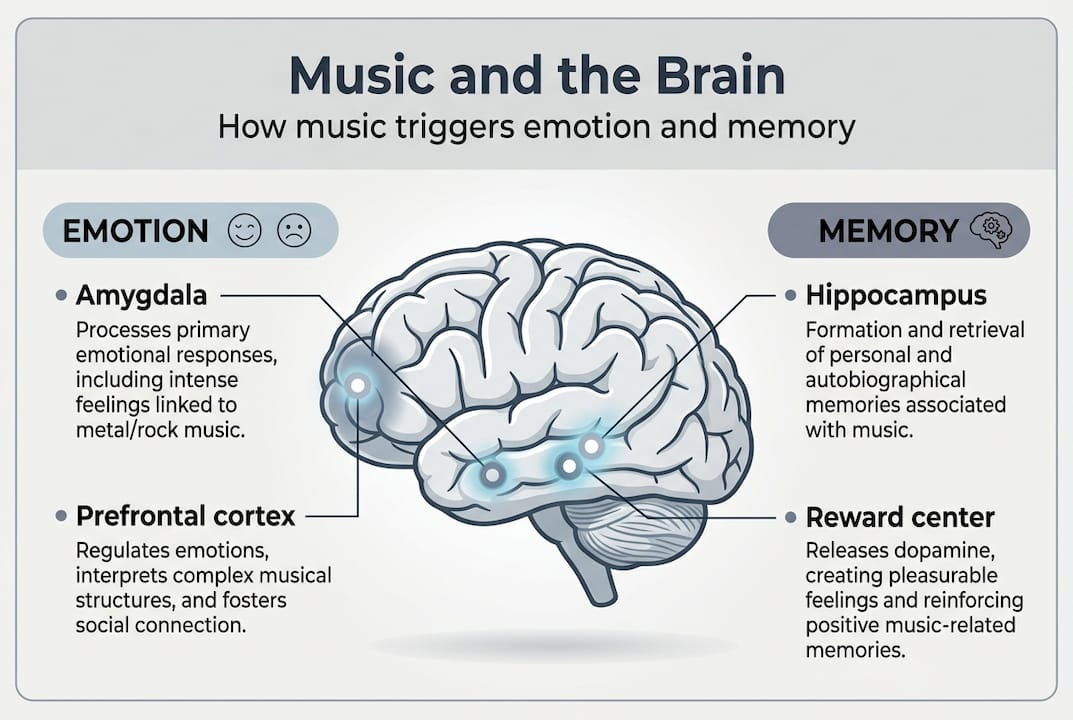
Here’s a quick look at the key brain areas activated during emotional music experiences:
Brain region | Role in music experience |
Amygdala | Processes emotional reactions, including chills and excitement |
Hippocampus | Links music to autobiographical memories |
Nucleus accumbens | Central to dopamine release and reward responses |
Prefrontal cortex | Regulates emotional response and personal meaning |
Self-selected music matters especially. When you choose what to play, you’re not just picking entertainment. You’re reinforcing who you are. Songs become part of your internal identity structure. The tracks you return to again and again are telling your brain, “this is who we are, this is what we value.”
Some key ways music triggers emotional and memory responses:
Familiar songs activate stronger dopamine responses than unfamiliar ones
Lyrics tied to personal experiences increase emotional salience
Tempo and key affect mood almost immediately, within seconds of listening
Repeated listening deepens neural encoding, making memories more vivid over time
Pro Tip: Build intentional listening habits. If you want a song to anchor a mood or memory, listen to it consistently in that emotional context. Your brain will create stronger associations each time.
Lyrics as personal storytelling: Impact on emotion and attitude
With the neural impact understood, the next piece is how words, lyrics, carry personal meaning and shape emotional landscapes in your musical journey. A great riff hits hard. But a lyric that says exactly what you couldn’t put into words? That cuts differently.
Lyrics have a medium to high effect on cognitive-behavioral outcomes, emotions, and attitudes, with prosocial lyrics increasing empathy and aggressive lyrics influencing hostility in certain listeners. This doesn’t mean hard rock or metal lyrics are harmful. It means lyrics are genuinely powerful tools, and context matters enormously. For fans who are drawn to intense music because it mirrors their real feelings, those lyrics become a form of validation, not provocation.
Here’s a direct comparison worth paying attention to:
Lyric type | Emotional effect on listeners | Fan experience in metal and hard rock |
Prosocial lyrics | Increased empathy, reduced isolation | Community feeling, shared struggle |
Aggressive lyrics | Can increase hostility in non-fans | Provides release and validation for fans |
Narrative lyrics | Builds emotional connection and story | Personal identification with themes |
Introspective lyrics | Encourages self-reflection | Supports identity formation and processing |
For fans of songwriting and emotion in the hard rock and metal world, the lyric-to-life connection is personal. We write from real experiences, and we know that when a listener hears something and thinks “that’s exactly my life,” something powerful happens between the artist and the fan.
Here’s a simple three-step framework that fans often go through when connecting deeply with lyrics:
Recognition. You hear a lyric and immediately recognize your own struggle or emotion in it. It doesn’t feel like someone else’s story anymore.
Validation. The lyric tells you that what you’re feeling is real and legitimate. You’re not alone, someone else lived it and put it into words.
Integration. Over time, the lyric becomes part of how you frame your own story. You reference it internally when facing similar experiences.
“Lyrics act as mirrors. When they reflect your life back at you, they stop being just music and start being evidence that your experience is real and shared.”
This is why so many fans describe metal and hard rock as the genre that got them through the hardest stretches of life. It’s not the volume. It’s the honesty in the words.

Catharsis and emotional regulation in hard rock and metal
Lyrics often connect personally, but the genre’s sound itself wields a unique kind of emotional power, especially for those seeking catharsis and regulation. Let’s be direct: the idea that heavy metal makes people angry or violent is not just wrong, it’s the opposite of what research actually shows.
Heavy metal provides genuine catharsis for fans. A study showed that angry metal fans who listened to extreme metal experienced reduced hostility and irritability, achieving relaxation similar to silence. That’s significant. It means for someone who is already angry, metal doesn’t pour fuel on the fire. It actually burns it off.
The concept at work here is catharsis, which is the emotional release that comes from experiencing something intense in a controlled, safe environment. Metal provides exactly that environment. You can feel everything, anger, grief, frustration, rebellion, without consequences. The music holds it for you while you process it.
The emotional release in metal that fans talk about isn’t just anecdotal. It’s documented. And the emotional power of hard rock runs through decades of music history precisely because fans kept returning to it when they needed to feel something real and get through to the other side.
Documented positive outcomes of heavy metal listening for fans include:
Stress reduction through high-intensity auditory engagement that mirrors and then dissipates tension
Mood improvement after processing difficult emotions through music rather than suppressing them
Increased energy and motivation, especially from driving rhythms and powerful guitar tones
Reduced feelings of isolation because the music reflects shared human experiences
Improved focus in some listeners, particularly during tasks that benefit from high-energy background sound
Sense of empowerment from themes of overcoming adversity and standing your ground
Pro Tip: When you’re feeling overwhelmed or stuck in a cycle of negative emotion, intentionally put on the heaviest track that matches how you feel. Let it go full volume for one song. Then slowly shift to something with a bit more resolution in the melody. You’re essentially walking your nervous system through the emotion rather than fighting it.
The stereotype of metal as aggression-inducing is frustrating because it ignores the lived experience of millions of fans who use this music as a genuine mental health tool. We’ve watched it firsthand. People come to shows carrying a lot, and they leave lighter. That’s not nothing.
Identity, social connection, and life stories through music
Beyond individual catharsis, music shapes our identities and communities, tying personal narratives together across shared life events. This is the piece of the conversation that often gets overlooked, probably because it’s harder to measure than a dopamine spike.
Research from Frontiers in Psychology confirms that for heavy metal fans, music evokes positive emotions like power and joy, enhances emotional regulation, identity development, and social connectedness, while non-fans may feel negative emotions from the same music. That last part is important. The same song can produce completely different effects depending on the listener’s relationship to the genre. For fans, it’s powerful. For outsiders, it can feel abrasive. That gap is cultural, not biological.
Understanding the rock music evolution across decades helps explain why these communities formed in the first place. Fans found each other through a shared language of guitar, drums, and lyrics that said what polite society often couldn’t or wouldn’t. That shared language became identity.
“When you know someone’s playlist, you know something real about them. Metal fans wear their music like a flag. It signals values, resilience, and belonging.”
Music helps fans tell their own life stories in several specific ways:
Soundtrack moments. Certain songs become permanently attached to real events, marking them with emotional color that plain memory often fades.
Processing difficulty. Hard periods in life get processed through repeated listening to music that mirrors the emotional weight of those experiences.
Expressing the inexpressible. When fans can’t articulate grief, rage, or joy in conversation, they play a track instead. The music speaks.
Community ritual. Concerts, shows, and even online fan spaces create shared experiences that build belonging over time.
Personal growth markers. The music you return to at different life stages tells a story about who you were and who you’ve become.
Innovation in how music reaches fans is also part of this identity story now. The way we’re using AI in rock music videos and production pushes the conversation forward, keeping the genre’s identity alive and evolving without losing what makes it essential. Fans aren’t just passive receivers. They’re co-creators of the culture.
The social dimension of metal fandom is real and durable. These aren’t casual listeners. They’re people who have built parts of their lives around a sound and a community. That’s identity formation at its most sincere.
A fresh perspective: Rethinking the impact of music in hard rock and metal
Here’s the uncomfortable truth that we think most people need to hear: the conversation about heavy metal and hard rock has been dominated for decades by people who don’t listen to it. Critics, parents, policymakers, all weighing in on a culture they’ve never actually lived inside.
We’ve spent years inside this music. We’ve seen what it does for people. The person in the back of the venue who hasn’t smiled in months finally letting go. The teenager who found our music during the worst year of their life and held on to it. The fan who messages us years later saying a lyric kept them going. That’s not aggression. That’s healing.
The metal music and well-being connection is backed by real research now, which is satisfying, but honestly we knew it long before any study confirmed it. Resilience lives in this music. Personal storytelling lives here. Community lives here.
Stop letting people who’ve never needed this music tell you what it does to you. You know what it does. Trust that.
Discover more: Explore hard rock and heavy metal stories
If this article resonated with you, you’re already part of a community that understands music as more than background sound. It’s lived experience, and it’s worth celebrating.
At Winter Agony, we’ve built our entire creative identity around the belief that music should be honest, emotional, and real. From our Kentucky roots in 2005 to our reunion and new tracks powered by cutting-edge AI technology, everything we do is for fans who feel music this deeply. We invite you to explore more stories, articles, and music at our hard rock and metal community. Dive deeper, find your people, and keep listening loud.
Frequently asked questions
How does music influence brain function during emotional experiences?
Music activates brain areas related to emotion, memory, and reward, producing dopamine and making emotional moments more memorable. Research confirms this includes engagement of identity circuits when listeners select their own music.
Can heavy metal music help with anger and mood regulation?
Yes, studies show listening to heavy metal helps fans process anger, reduce hostility, and achieve relaxation similar to silence. The cathartic effect is especially strong for those who already identify as fans of the genre.
Why do lyrics in hard rock and metal matter for fans?
Lyrics in these genres often tell personal stories and mirror real struggles, providing emotional validation and release that goes far beyond entertainment. Fans describe lyrics as mirrors that make their experiences feel seen and legitimate.
Are there risks to listening to metal music?
While fans benefit from catharsis, non-fans may experience negative emotions, and over-reliance on extreme music can pose mood risks in certain contexts. Research shows the benefits are strongest when the listener already has a positive relationship with the genre.
How does music shape social connection in hard rock and metal fandom?
Music fosters strong communities, positive emotions, and a sense of identity for fans, strengthening social bonds across generations. Frontiers in Psychology documents how heavy metal specifically enhances identity development and social connectedness for its fans.
Recommended
Comments