


Hard rock vs heavy metal: How to tell the true difference
- Travis B
- 1 day ago
- 10 min read


Even lifelong fans of loud, distorted guitar music have been there — you’re in a conversation about a song you love, you call it hard rock, and someone across the room says “that’s definitely metal.” Suddenly you’re both pulling out arguments neither of you can fully back up. The truth is, genre boundaries are often blurry even for seasoned listeners, and there’s real history behind that confusion. We’re going to walk through the core differences, overlaps, and practical signals that can actually help you tell the two apart, without turning it into an academic debate you never asked for.
Table of Contents
Key Takeaways
Point | Details |
Genre lines are blurry | Hard rock and heavy metal have overlapping histories and many hybrid bands. |
Sound is the main clue | Listen for groove and blues in hard rock and for intensity and speed in heavy metal. |
Emotion spans both genres | Both styles deliver emotional lyrics, but differ in arrangement and delivery. |
Hybrid bands exist | Some bands can’t be easily classified and bridge both genres. |
Enjoy the music first | Genre labels are a helpful guide, but shouldn’t limit your musical exploration. |
Why are hard rock and heavy metal so often confused?
Let’s start by exploring why even the experts and critics can’t always agree on where hard rock ends and heavy metal begins.
Back in the late 1960s and early 1970s, there were no genre gatekeepers. Music journalists tossed around terms like “hard rock” and “heavy metal” almost interchangeably, applying them to anything loud and guitar-driven. Nobody was filing records under strict categories. Fans just bought what sounded good, and bands played what felt right.
“Hard rock and heavy metal overlap heavily, and genre boundaries are often blurry; hard rock’s roots are blues-based while heavy metal tends to push riffs and intensity further, becoming more differentiated into substyles especially from the 1980s onward.” — Wikipedia on hard rock
The rock music evolution from blues-drenched garage bands into the stadium-filling giants of the 1970s happened fast and messy. Bands were building new sounds without a rulebook. That’s actually beautiful, but it makes labeling retroactively a real headache.
Key reasons the confusion runs deep:
Shared roots. Both genres grew directly from blues rock and psychedelic rock. The same guitarists, the same amplifier setups, sometimes even the same stages.
Genre-crossing icons. Led Zeppelin, Deep Purple, and Black Sabbath are each claimed by both camps. Depending on which song you pick, you can make a case for either genre.
Shifting definitions. What counted as “metal” in 1972 is not what fans mean by metal in 2026. The labels drifted as the music evolved.
No central authority. There was never a governing body that officially defined these genres. Critics, fans, and record labels each drew their own lines.
This genre label drift is something music historians have noted for years. The 1980s brought more separation as glam metal, thrash, and power metal carved out distinct identities. But even then, bands like Bon Jovi confused people who expected cleaner divisions. By the time MTV started sorting bands into playlists, the horses were already out of the barn.
The good news? Understanding why the confusion exists makes it way easier to work with the distinctions that do hold up. Check out this deep look at the top hard rock bands if you want specific examples of where these labels got applied and why.
Hard rock vs heavy metal: Core sound differences
Now that you know the genres’ histories are intertwined, let’s see what makes them sound different to your ears.
This is where things get practical. When you close your eyes and just listen, there are specific musical signals that point you toward one genre or the other. It’s not about what a music journalist decided in 1978. It’s about what’s actually happening in the song.
Hard rock prioritizes groove, hooks, and blues-influenced accessibility, while heavy metal emphasizes greater aggression and intensity, often with faster tempos and thicker, more distorted guitar tones. That one sentence covers a lot, so let’s pull it apart.
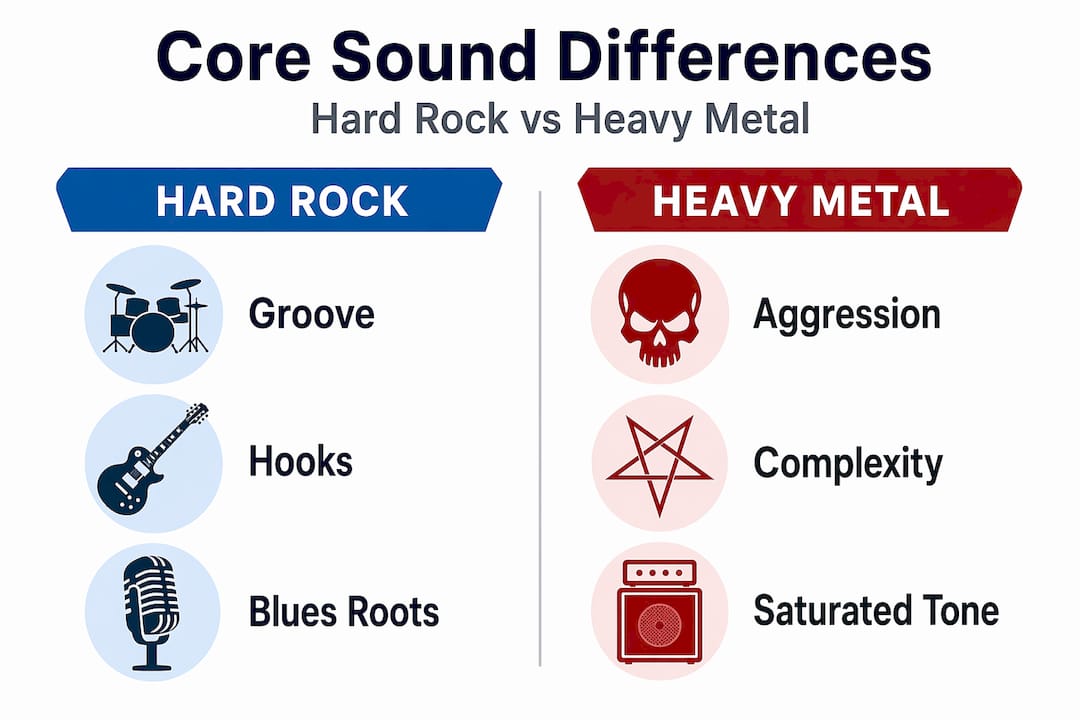
Here’s a side-by-side comparison of key sonic elements:
Element | Hard rock | Heavy metal |
Guitar tone | Crunchy, warm distortion | Thick, heavily saturated distortion |
Tempo | Mid-range, groove-focused | Often faster, sometimes relentlessly driving |
Riff style | Bluesy, hook-driven | Aggressive, technically complex |
Vocals | Melodic, anthemic, accessible | Rawer, more intense, occasionally harsh |
Song structure | Verse-chorus-driven, radio-friendly | Longer, more complex, less hook-dependent |
Aggression level | Moderate to high | High to extreme |
Blues influence | Strong | Diminished or absent |
Looking at that table, you start to see patterns. Hard rock keeps the blues DNA intact. You can hear it in the guitar bends, the swing in the rhythm, the way a riff breathes and gives you space to move. Heavy metal tends to remove that breathing room. Riffs lock in tight. Tempos push harder. The intent shifts from making you groove to making you feel overwhelmed in the best possible way.
Other sound characteristics worth noting:
Bass role. In hard rock, bass often follows the groove and adds warmth. In heavy metal, bass can either mirror the guitar for added thickness or be buried under layers of distortion.
Drum patterns. Hard rock drumming tends to emphasize the backbeat. Metal drumming often involves double bass pedals, blast beats, or intricate fills that push intensity forward.
Production style. Hard rock productions often sound polished and warm. Metal productions, especially from the 1980s onward, tend to be drier, heavier, with guitars pushed further forward in the mix.
The hard rock sound and history comes from decades of players borrowing from blues, adding crunch, and finding the point where rock gets genuinely powerful without losing the groove. Metal then took that power and decided it wasn’t enough, pushing further into sonic territory that prioritizes intensity over accessibility. Understanding music production in rock helps you hear these differences more clearly once you know what to listen for.
Pro Tip: Next time you’re trying to place a song, ask yourself whether it makes you want to nod your head to a groove or whether it makes you want to clench your fist because the intensity won’t let up. That physical reaction is often your most reliable genre indicator.

Lyrics, emotions, and listener impact: What really separates them?
Sound isn’t the whole story. Let’s dive into how emotions and lyrics draw lines for listeners seeking personal connection.
We’ve always believed, as a band, that music hits hardest when it’s rooted in real experience. That’s true in both hard rock and heavy metal. But the way each genre delivers that emotional content differs in meaningful ways.
Hard rock has a long tradition of anthemic, relatable storytelling. Songs about relationships falling apart, about standing up after getting knocked down, about freedom and rebellion. These themes are universal and the music frames them in a way that feels accessible. You can sing along on the first listen because the chorus is designed to land.
Heavy metal goes somewhere different. The emotional register often shifts toward darker or more abstract territory. Existential dread, fantasy narratives, inner struggle, and confrontations with mortality are common. That’s not to say metal is always dark for darkness’s sake. It’s more that metal tends to put emotional weight on a set of themes that hard rock doesn’t always visit.
Here’s how emotional delivery tends to differ between the two genres:
Vocal delivery. Hard rock singers often carry melodic hooks even during intense moments. Metal vocalists frequently lean into rawness, aggression, or theatricality.
Lyrical density. Heavy metal lyrics can pack in more imagery and narrative complexity per song. Hard rock tends toward punchy, repeatable lines that stay with you.
Emotional arc of a song. A hard rock track often builds toward a triumphant chorus. A metal track might escalate into chaos, never resolving the tension at all.
Arrangement intensity. Metal arrangements tend to keep the emotional pressure high throughout the song. Hard rock arrangements often use dynamic shifts, pulling back before the big moment hits.
Listener identification. Hard rock asks you to see yourself in the story. Metal sometimes asks you to confront something uncomfortable inside yourself.
The most reliable discriminator for emotionally driven listeners is not lyrics alone, but the combination of arrangement approach, riff function, groove versus speed and complexity, distortion intensity, together with vocal delivery and thematic density. Even then, crossover bands exist all over the place.
For those of us who found these genres because we needed music that reflects real life, the distinction matters less than the impact. But knowing what a genre typically delivers emotionally helps you find music that matches exactly what you’re feeling. You want the gut-punch catharsis of metal or the arm-around-the-shoulder solidarity of hard rock? Now you know where to look. And emotion in metal music is its own study in how music affects well-being and personal identity.
Pro Tip: Pay attention to the moment a vocalist hits the chorus. If it feels like a release and a reward, you’re probably in hard rock territory. If the chorus hits like a wall and keeps building pressure, that’s more likely metal.
Understanding the emotional impact of hard rock and how it differs from metal’s emotional delivery can genuinely change how you relate to both genres.
The gray zone: Hybrid bands and genre-bending examples
With all these rules, why do genre debates rage on? Because some bands simply defy categorization.
Here’s an honest reality. The bands that matter most to people are often the ones that break every rule we just laid out. Led Zeppelin could swing between acoustic folk and crushing heaviness in the same album. Deep Purple had jazz training, classical influences, and riffs that hit like a freight train. Black Sabbath invented a whole sonic world that didn’t fully exist before them.
Band | Famous song | Era | Genre label (varies by source) |
Led Zeppelin | “Whole Lotta Love” | Early 1970s | Hard rock / proto-metal |
Deep Purple | “Smoke on the Water” | Early 1970s | Hard rock / heavy metal |
Black Sabbath | “Iron Man” | Early 1970s | Heavy metal / proto-metal |
Early Metallica | “Seek and Destroy” | Early 1980s | Thrash metal / heavy metal |
AC/DC | “Back in Black” | 1980 | Hard rock / heavy metal (debated) |
The genre hybridization debate is real and documented. Early metal terminology was applied loosely in the 1970s before clearer 1980s genre identities solidified. And many prominent acts intentionally blur the line, which is part of what makes them exciting.
Signs you’re listening to something in the gray zone:
The song starts with a slow, bluesy groove and then erupts into crushing intensity
Critics across different publications have labeled the same band under completely different genres
The band’s first album sounds like hard rock and their third album sounds like metal
You feel like you’re in both genres at the same time and neither label fully fits
The real lesson here is that innovation in rock and metal has always pushed past category walls. The artists who matter most in both genres are usually the ones who never quite fit the boxes neatly.
Why the hard rock vs heavy metal debate shouldn’t limit your music journey
Here’s our honest take after years of writing, playing, and living inside these genres. Genre labels are a starting point, not a destination.
We’ve seen fans get genuinely frustrated because a band they love gets lumped into the wrong category. We’ve also seen people avoid entire bodies of work because they decided they “don’t listen to metal” or “only listen to real rock.” That’s a real loss, and it happens because genre tags get treated as identity markers rather than rough descriptors.
The classification instability that makes fans argue is actually a sign that the music was alive and always moving. The fact that you can’t fully pin down Led Zeppelin or Black Sabbath isn’t a problem with the music. It’s proof that genuine creative ambition doesn’t sit still.
We started Winter Agony in Kentucky in 2005 because we needed to say things that didn’t fit neatly anywhere. Personal struggle, resilience, the kind of raw honesty that only comes out when the guitars are loud enough to drown everything else. We’ve been called hard rock. We’ve been called metal. We take both as a compliment.
The most powerful emotional moments we’ve experienced as musicians and as listeners came from tracks that didn’t obey genre rules. A slow, bluesy hard rock intro that suddenly drops into a wall of distortion and screaming. A metal track with one melody so clear and aching you never forget it. Those are the moments that live with you for years.
Try this as a genuine challenge: follow what moves you for one month. Don’t check genre tags. Just listen and chase the feeling. You’ll probably end up in corners of both hard rock and metal that you never would have found if you’d stayed on the labeled path. The fan experience is always richer when you let go of the categories and trust your gut.
Genre knowledge is a tool. Use it to find more music, not to close doors.
Discover more on hard rock, heavy metal, and your journey
Ready to keep exploring the meaning and impact of these powerful genres?
We’ve only scratched the surface here. The world of hard rock and heavy metal is vast, personal, and full of stories that connect directly to real human experience. Whether you’re just starting out or you’ve been a fan for decades, there’s always more to discover.
If you want to go deeper into how life through hard rock and metal shapes who we are and how we process our experiences, we’ve put together guides that go way beyond surface-level genre discussion. From personal stories to production breakdowns, the Winter Agony site is built for fans who want the full picture. Come explore it with us. We built this space for listeners who feel what we feel when the music hits right.
Frequently asked questions
Is Led Zeppelin hard rock or heavy metal?
Led Zeppelin is primarily categorized as hard rock, but some of their tracks, especially in the early 1970s, were labeled as heavy metal due to their heavy riffs. As early metal terminology was applied loosely before clearer genre identities solidified, both labels show up in different sources.
What are defining musical characteristics of heavy metal?
Heavy metal usually features thicker and more distorted guitar tones, faster tempos, greater complexity, and a rawer vocal delivery. According to fan-recognized distinctions, heavy metal emphasizes greater aggression and intensity compared to hard rock’s groove and blues-influenced hooks.
Why do hard rock and heavy metal often get confused?
The genres overlapped heavily in their early years and many bands blur the line with hybrid sounds and evolving styles. As genre boundaries remain blurry, even today the shared roots of both genres make clean separation difficult for fans and critics alike.
Can lyrics alone distinguish hard rock from heavy metal?
No. While both genres can feature emotional lyrics, the arrangement, riff style, and vocal delivery are more reliable clues. The most reliable genre discriminator for emotionally driven listeners is the combination of arrangement approach, distortion intensity, and vocal delivery rather than lyrical content alone.
Recommended
Comments