


How to express emotion in rock and metal music
- Travis B
- 5 days ago
- 8 min read

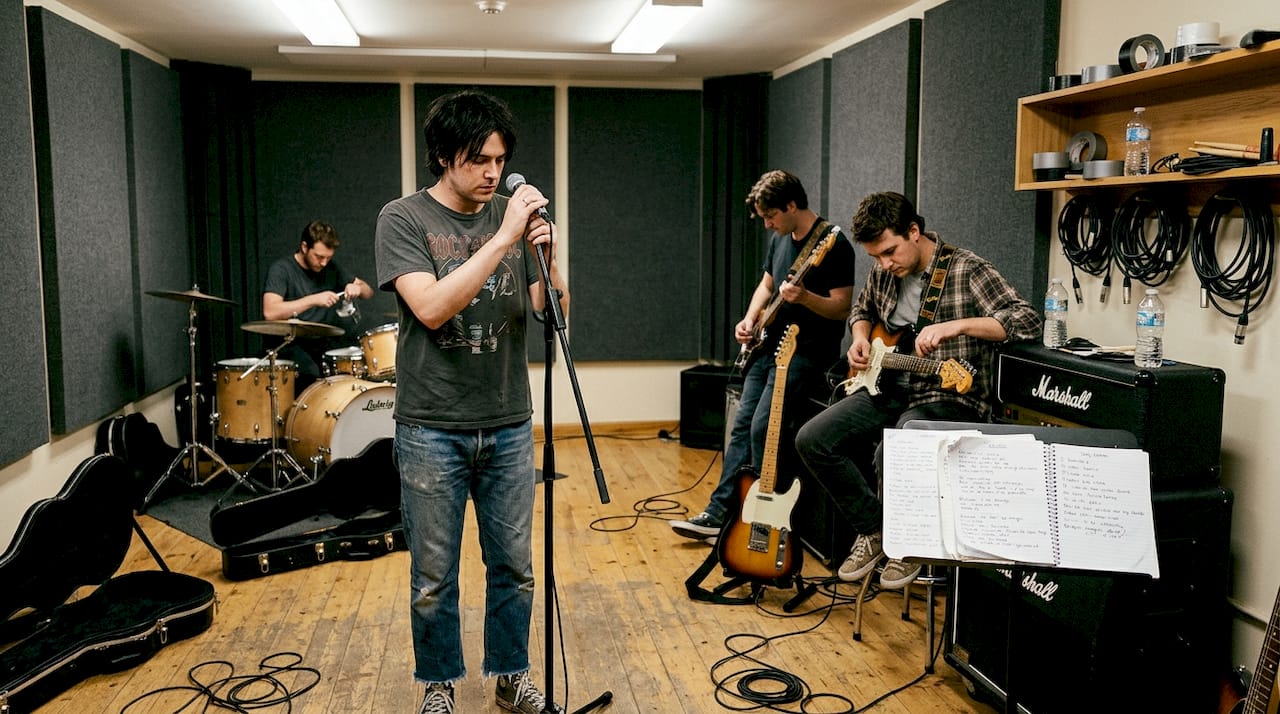
You can feel it in the room. One band walks onstage and the crowd goes through the motions. Another hits the first chord and something shifts, something physical and real that grabs you in the chest. Most rock and metal musicians can play the notes. The harder thing is making those notes mean something. Whether you’re writing a riff at 2 a.m. or standing behind a microphone trying to channel three years of pain into a three-minute song, the gap between technical skill and genuine emotional connection is where most of us get stuck. This guide is about closing that gap, step by step, with real methods built for rock and metal.
Table of Contents
Key Takeaways
Point | Details |
Mindset matters | Starting with a clear emotional intent improves your ability to express emotion in music. |
Match mode to mood | Using major and minor modes properly shapes the emotional tone of rock and metal songs. |
Vocal and lyric power | Harnessing vocal styles and meaningful lyrics channels raw emotion effectively. |
Performance amplifies emotion | Stage presence and production choices can elevate emotional connection with your audience. |
Preparing to express emotion: Mindset, tools, and influences
Before you write a single chord progression or scratch out a lyric, you need to get honest with yourself about what you’re actually trying to say. That sounds obvious, but most musicians skip this step entirely. They sit down at their instrument and wait for something to happen instead of deciding what emotional territory they want to explore. Emotional authenticity starts with that decision. What is the core feeling driving this song? Anger? Grief? Defiance? Name it before you play a note.
Good songwriting fuels emotion when the songwriter already knows what they feel. That’s the foundation. Everything else, your guitar, your DAW, your vocal chain, is just a vehicle for that feeling.
Here’s what you need in your creative toolkit:
Instruments tuned to your intent: Drop tunings and downtuned guitars naturally carry weight. Bright, open tunings feel different emotionally.
A DAW you trust: Whether it’s Pro Tools, Logic, or Reaper, your recording environment should feel like a creative space, not an obstacle.
Reference tracks: Songs that already do what you want to do emotionally. Study them. Steal the feeling, not the notes.
Vocal resources: From microphone choice to breath control exercises, your voice deserves as much prep as your guitar tone.
A journal or voice memo app: Capture the raw emotional moment before it disappears.
Your influences matter more than you might think. Artists like Layne Staley, Chester Bennington, or Corey Taylor didn’t just perform. They bled. Studying how those musicians translated personal darkness into accessible music gives you a blueprint without making you a copy.
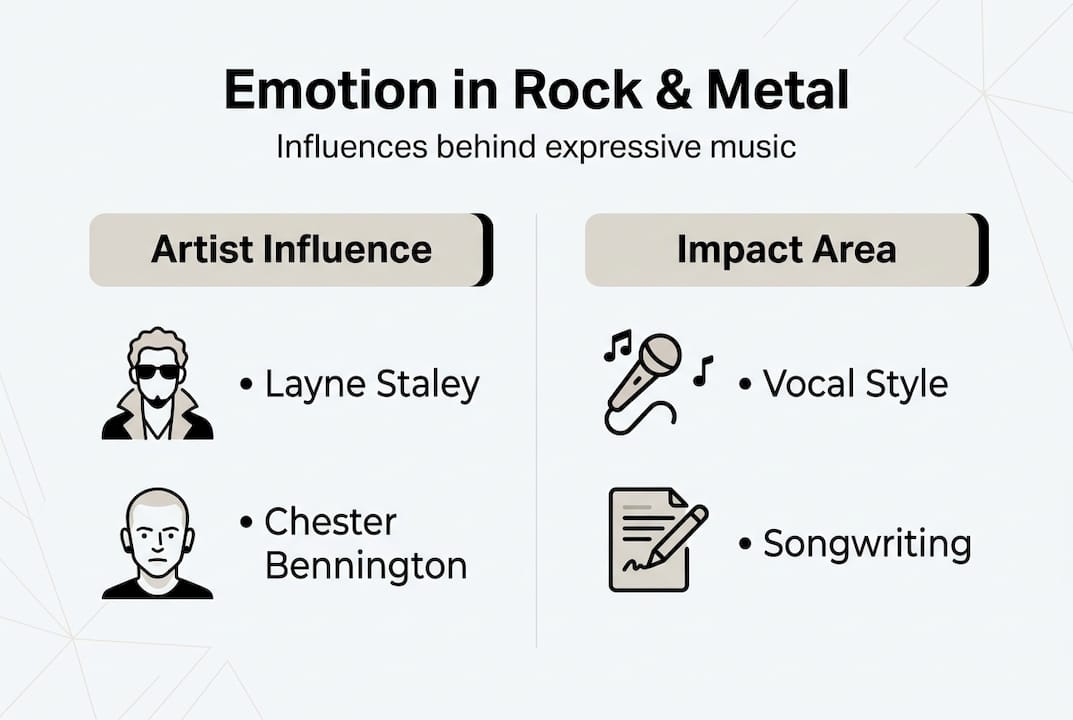
One of the most powerful tools you have is musical mode. Research on emotion and musical modes confirms that minor modes correlate with sadness and fear, while major modes map to happiness and brightness. This isn’t just theory. It’s a practical decision you make at the start of every song.
Mode/Key | Emotional association | Common rock/metal use |
Minor | Sadness, fear, tension | Doom metal, ballads, emo |
Major | Joy, triumph, energy | Anthems, uplifting rock |
Phrygian | Darkness, exotic tension | Thrash metal, death metal |
Dorian | Melancholy, cool sadness | Blues-influenced rock |
Pro Tip: Before you open your DAW, write down one word that describes the emotional core of the song you’re about to write. Put it on a sticky note next to your monitor. Every production decision after that should serve that one word.
Step-by-step: Matching musical elements to emotion
Now that you’ve got your mindset set and your tools ready, it’s time to make concrete musical decisions. This is where the emotion on the page becomes emotion in the speakers.
Step 1: Choose your mode and scale first. Don’t just jam until something sounds good. Decide whether the song lives in a minor or major world. Studies on musical mode emotion research back up what any experienced rock musician already feels: minor scales evoke darkness and major scales carry light. Start with intent.
Step 2: Set your tempo deliberately. Slower tempos amplify grief and weight. Think 60 to 80 BPM for crushingly heavy emotional material. Faster tempos, above 150 BPM, spike adrenaline and aggression. Don’t default to whatever feels natural in the moment. Choose the tempo the emotion demands.
Step 3: Map your dynamics. Dynamics are the difference between a song that says something and one that just makes noise. Build from quiet to loud, or loud to devastatingly quiet. That contrast is where emotional impact lives.
Step 4: Choose instrumentation that fits the feeling. Aggressive, distorted guitars carry rage and power. Clean melodic keys or acoustic guitar carry vulnerability. You can layer both in the same song for contrast, and often that’s where the magic is in music creativity in hard rock.
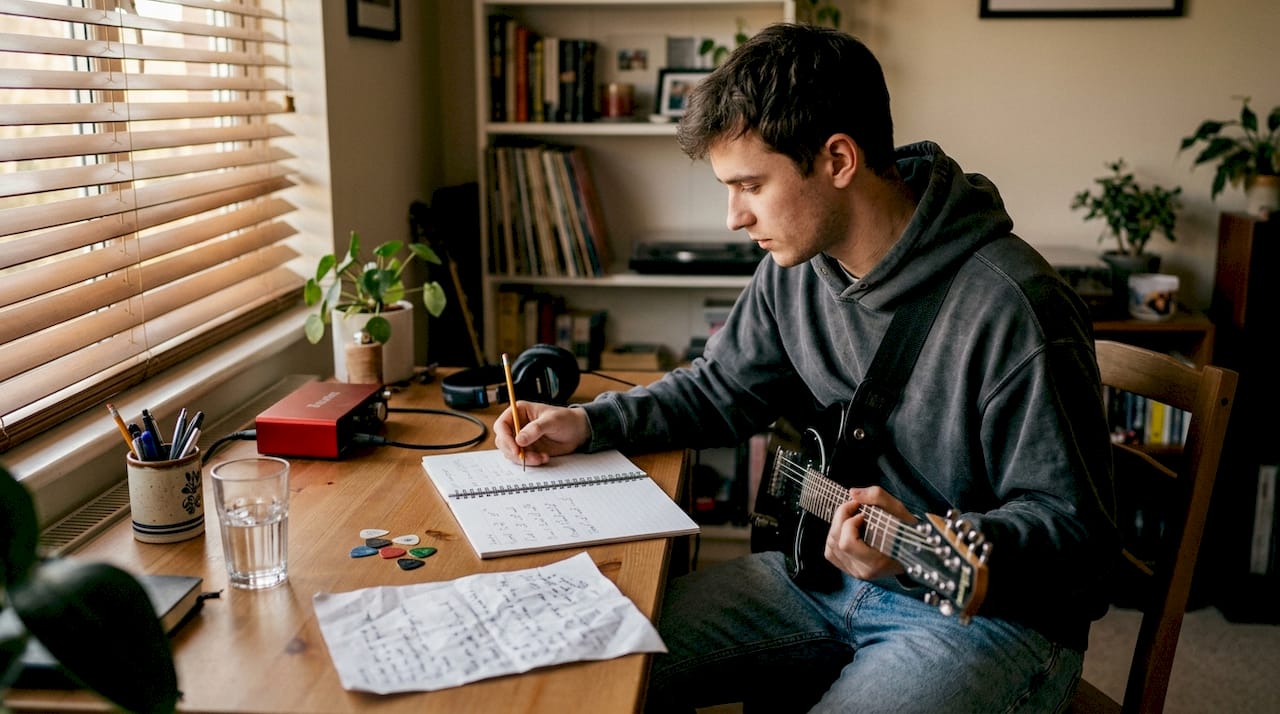
Step 5: Record a rough demo with the emotional intent in mind. Don’t wait for the perfect take. Capture the feeling, even if it’s messy. You can refine the performance later. You can’t manufacture the raw emotion that happens in the moment.
Musical element | Low intensity emotion | High intensity emotion |
Tempo | 60 to 80 BPM | 150 to 200+ BPM |
Dynamics | Controlled, subtle shifts | Dramatic swells and drops |
Guitar tone | Clean or light overdrive | Heavy distortion, high gain |
Arrangement | Sparse, minimal layers | Dense, layered, wall of sound |
Pro Tip: Try writing the same riff in both a minor and a major key and record both versions back to back. The difference will make the research real for you in a way no explanation can.
Vocal techniques and lyrics: Channeling raw emotion
If your music is the body of the song, vocals are the face. They’re what listeners lock onto first, and they’re the most direct line between your internal experience and the listener’s. In rock and metal especially, you have a wider vocal toolkit than almost any other genre.
Metal vocal techniques are built for emotional range. Screams and growls channel anger and frustration in a way clean singing simply cannot replicate. Clean singing, on the other hand, delivers melody and lyrical clarity, letting words land with precision. The best metal and hard rock performers know when to use each, and they match the vocal approach to what the lyric is actually saying.
Here’s how to think about matching vocal style to emotional content:
Screams and growls: Use these when the emotion is too big to speak. Rage, helplessness, desperation.
Clean singing: Use this for vulnerability, clarity, and moments you want the listener to hold onto.
Mixed or transitional techniques: Move between styles mid-song to mirror emotional shifts. This is one of the most powerful tools in your vocal arsenal.
Vocal tone and placement: A low, chest-heavy tone feels grounded and serious. A higher, airier tone feels fragile or yearning.
Breath and pacing: Holding a note longer than expected creates tension. Cutting a phrase short can feel like emotional collapse.
“The voice is where all the vulnerability lives. You can hide behind your guitar, but you can’t hide behind your voice.” This is something we come back to every time we’re in the studio. The moment a vocalist stops performing and starts feeling, the recording changes completely.
For lyrics, the rule is specificity. “I was sad” tells the listener nothing. “I sat in the parking lot for forty minutes because I couldn’t walk inside” shows them the moment and puts them inside it. That specificity is what makes emotion in metal music land with fans. And if you’re exploring new ways to deliver vocal performances, some artists are now experimenting with innovative music videos and AI-assisted vocal tools to push creative limits without losing authenticity.
Performance and production: Conveying emotion to your audience
You’ve written the song. You’ve tracked the vocals. Now the question is whether the final recording and the live performance actually carry that emotion to another human being. That’s a separate skill and it’s worth treating it that way.
In music production in rock and metal, your mixing and mastering decisions are emotional decisions. Reverb adds space and distance. Compression controls the aggression and punch. Layering guitars creates a sense of overwhelming weight. These aren’t just technical choices. They’re how the emotion survives from the recording room to the listener’s headphones.
Here are production and performance elements that directly impact emotional delivery:
Reverb and delay: Large, wet reverb makes vocals feel lonely or expansive. Tight, dry settings feel claustrophobic or urgent.
Guitar layering: Double-tracking and panning guitars wide creates a wall of sound that feels physically large, which is ideal for emotional climaxes.
Dynamic mix: Don’t make everything equally loud. Let the quiet moments breathe. That contrast makes the loud moments hit harder.
Live movement: Stillness onstage during a heavy moment can be as powerful as throwing yourself across the stage. Be intentional with your body.
Eye contact with the audience: It transforms performance from entertainment to conversation. Listeners feel addressed, not just entertained.
Vocal techniques in performance: As confirmed by metal vocal research, matching vocal style to the emotional intent of each section keeps audiences locked in.
Pro Tip: When you’re mixing, close your eyes and just listen to the song without looking at the meters. Ask yourself: what does this feel like right now? If the answer doesn’t match the intended emotion, something in the mix needs to change.
Our take: The myths and realities of emotion in metal and rock
Here’s something we’ve learned after years of writing, recording, and performing: the musicians who try to manufacture emotion are always the ones who fall flat. You can hear it. There’s a difference between someone who’s performing sadness and someone who’s actually carrying it into the room with them.
The myth is that emotional music requires extraordinary pain or trauma. It doesn’t. What it requires is honesty. The willingness to stop protecting yourself from your own feelings long enough to write them down. We’ve watched technically flawless musicians leave audiences cold because everything was controlled and nothing was real. And we’ve watched imperfect performances create lifelong fans because the person onstage was visibly, undeniably human.
Formulaic songwriting can get you decent music. Honest songwriting gets you fan emotional connection that lasts. Audiences in rock and metal are especially sharp at detecting inauthenticity. They’ve been burned by it before, and they have zero patience for it. What they crave is someone willing to go first, to feel the thing in public and trust the crowd to meet them there.
How Winter Agony helps musicians express emotion
If this guide resonated with you, know that you don’t have to figure it out alone. At Winter Agony, we’ve been doing exactly this work since 2005, writing music from real experience, failing, learning, and coming back stronger every time.

Our site is built as a resource for rock and metal musicians who want more than just gear reviews and theory lessons. We share the real stuff: the creative struggles, the production breakthroughs, the hard lessons from the road and the studio. Whether you’re a songwriter looking for community or a musician wanting to go deeper, explore the emotional rock scene we’ve been building for over two decades. Come find your people.
Frequently asked questions
What musical modes are best for expressing sadness or fear in rock and metal?
Minor modes are scientifically linked to sadness and fear, making them the natural starting point for heavy, emotionally dark material in rock and metal.
How do vocal techniques in metal music communicate emotion?
Screams and growls convey anger and frustration while clean singing delivers lyrical clarity and melody, and skilled performers match whichever approach fits the emotional moment in the song.
Can music production choices impact emotional expression in recorded songs?
Absolutely. Production decisions like reverb, dynamic mixing, and guitar layering directly shape how the emotion in a recording is felt by the listener.
What role do lyrics play in expressing emotion in rock and metal?
Lyrics are the most direct form of storytelling in a song, and specific, honest writing creates an emotional bridge between the artist’s experience and the listener’s own feelings.
Recommended
Comments